Company
Learn

LevelUp Blog

LevelUp Blog

Read the latest articles on our achievements, client success, and let us share the knowledge.
Generic selectors
Exact matches only
Search in title
Search in content
Post Type Selectors
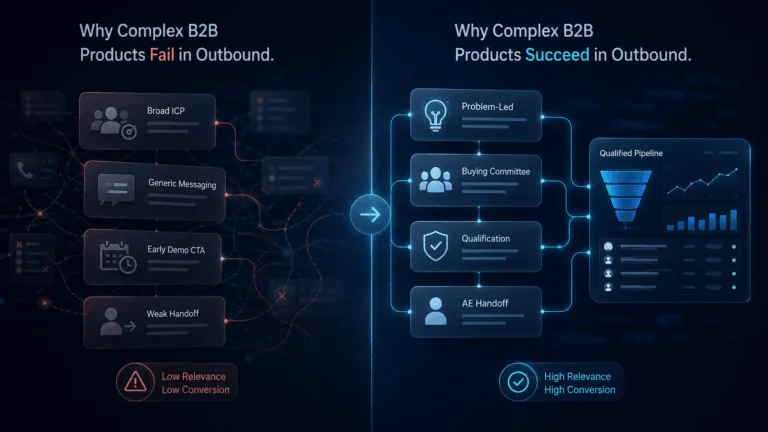
Complex B2B outbound requires more than volume. It needs precise ICP selection, market-aligned messaging, buying committee awareness, strong qualification, and clean AE handoff.
Neither model is universally better.

A dedicated SDR team is usually stronger for complex B2B sales, higher ACV, narrow ICPs, longer sales cycles, and outbound motions that require deep product, persona, and objection knowledge.

A shared SDR team can work for simpler offers, early market testing, lower-volume programs, budget-constrained teams, or companies that need light outbound coverage before committing to a full pod.
The mistake is choosing based only on cost.
Most digital marketing agencies routinely miss what makes Shopify search performance different, namely collection page architecture, Liquid template structure, product schema, faceted navigation, and the app-driven page speed issues that quietly tank rankings.

Standard SEO playbooks were not built for Shopify, and brands that hire generalist agencies often end up paying for traffic that never converts.
Modern cold call objection handling is not about memorizing clever rebuttals. It is about diagnosing the objection, responding clearly, and using the right follow-up channel.

That is the bigger shift: cold calling works best when it is part of a multichannel outbound motion that includes phone, email, LinkedIn, CRM discipline, and AE feedback. Recent cold calling guidance also frames modern calling as targeted, contextual, and integrated into email and LinkedIn sequences, not as isolated dialing.
B2B buyers engage across more channels than ever, and that complexity creates real challenges for marketers. Understanding where common breakdowns happen, and how to solve them can turn fragmented efforts into coordinated growth.
Let's be honest: most lead scoring systems are running on autopilot with outdated rules that someone set up three years ago and never touched again.
You know the drill. Someone downloads a whitepaper? Add 10 points. They visit the pricing page? Another 15 points. Hit 50 points total, and boom, they're "sales qualified." Your sales team gets the lead, makes the call, and... nothing. The prospect was just doing research. Or the prospect was a student. Or they already bought from your competitor six months ago.
Sound familiar?
The problem isn't that lead scoring is broken,it's that the way most of us are doing it hasn't kept pace with how buyers actually behave today. And worse, we're drowning in so many inbound leads that we can't separate the tire-kickers from the people ready to buy.
Here's the good news: AI is finally making lead scoring actually work the way it was supposed to.
Businesses today are faced with unprecedented challenges. From economic uncertainty to increased competition to the pressure to do more with less, it is more difficult than ever to generate revenue. With rapidly evolving technological advances, companies are up against more competition, but with fewer resources to stand out. Budget cuts mean smaller teams, and yet today’s customers expect more from sales outreach, including a more personalized experience, faster response times, and more.

With all of these obstacles threatening sales teams’ success, it’s no wonder that so many companies are turning to outsourced appointment-setting firms to help ease the load. Appointment-setting companies not only help supplement sales staff, they are also equipped with expert knowledge and specialized strategies to help businesses increase their pipelines and grow their ROI.

We’ve rounded up the best B2B appointment-setting companies to consider for 2026 (and beyond). Find out what makes each of these appointment-setting agencies unique and how to choose the right one for your business.
B2B buyers don’t move in straight lines anymore, they jump between channels, research on their own, and expect seamless relevance. Mapping the customer journey brings clarity to these touchpoints and helps teams engage smarter at every step.
If you want the short answer first, here it is:
For most B2B appointment setting teams, a power dialer is the better default choice. It gives reps more control, more context, and better conditions for quality conversations. A parallel dialer can outperform it in the right situation, but usually only when you are working large cold lists, optimizing for connect volume, and operating with tighter controls.

That is the real comparison.

This is not just a question of speed. It is a question of what kind of meetings you want to create, what kind of list you are calling, and how much operational complexity your team can handle.

In this guide, we will break down the difference between a power dialer and a parallel dialer, when each works best, and which one is more likely to improve B2B appointment setting results.
Kicking off with a stat bomb: cold email metrics in 2025 are eye-opening. Here are three shockers:
  • Avg. Open Rate: ~42% across industries (nearly half of recipients).
  • Reply Rates: Very low (~1–4%) – only ~5% of senders personalize each email, yet those see 2–3× the replies. AI can help you join that top 5%.
  • Case Study: One SaaS startup sent 400 targeted emails via Smartlead and booked 61 demos (≈15%) in 8 weeks – a conversion rate multiple times above their earlier campaigns.
SUBSCRIBE NOW

Do you want to be aware of all the updates?

This field is for validation purposes and should be left unchanged.