


Key Takeaways
A dedicated SDR model gives your company assigned SDR resources that focus primarily or exclusively on your account. A shared SDR model gives you access to SDR capacity across a pool of reps who work on multiple clients or campaigns.
The better question is: which model protects pipeline quality for your sales motion?
What is a dedicated SDR model?
A dedicated SDR model is an outsourced SDR engagement model where one or more SDRs are assigned to your company, campaign, ICP, or territory.
In a dedicated setup, the SDR team learns your:
- ICP
- Buyer personas
- Messaging
- Offer positioning
- Objection patterns
- CRM workflow
- Sales handoff process
- Qualification criteria
- Competitors
- Product or service details
Dedicated outsourced SDR providers often position this model around deeper team integration, CRM alignment, consistent pipeline support, and scalable outbound capacity. (Rev-Empire)
What is a shared SDR model?
A shared SDR model is an outsourced sales development structure where SDR resources are distributed across multiple clients, campaigns, or accounts.
A shared SDR may work on your campaign for a portion of the week while also supporting other companies.
This model is usually lighter, more flexible, and less expensive than a fully dedicated pod.
It can make sense when:
- The offer is simple.
- The ICP is broad.
- The goal is early testing.
- The sales cycle is shorter.
- The required product knowledge is limited.
- The company does not yet need full-time SDR capacity.
The risk is that shared SDRs may not build enough context to represent complex offers well. Some current SDR outsourcing discussions specifically warn that shared pools can lead to generic outreach, weak brand representation, and inconsistent follow-up when the SDR is stretched across too many clients. (LinkedIn)
What is an SDR pod structure?
An SDR pod structure is a team design where SDRs work in a focused unit with defined roles, campaigns, accounts, or territories. In outsourced SDR, a pod may include:
- SDR or SDRs
- SDR manager
- Campaign strategist
- List builder or data researcher
- Copywriter or messaging strategist
- RevOps support
- Client success or account lead
In broader sales org design, pods are often used to create more agile, focused teams around a market, segment, product, or customer group. Sales pod models are commonly described as a way to break down silos and align sales, marketing, and customer functions around shared outcomes. (Winning by Design)
For outsourced SDR buyers, the important question is not whether the vendor uses the word “pod.”
The question is:
Who is actually assigned to your account, how much time do they spend on your market, and who owns performance quality?
Dedicated SDR model vs shared SDR model: quick comparison
|
Factor |
Dedicated SDR model |
Shared SDR model |
|
Best for |
Complex, high-value outbound |
Simpler or early-stage outbound |
|
Cost |
Higher |
Lower |
|
Context depth |
Higher |
Lower to moderate |
|
Brand familiarity |
Stronger |
Weaker unless managed well |
|
ICP complexity |
Better fit |
Riskier |
|
Speed to launch |
Moderate |
Faster |
|
Flexibility |
Moderate |
Higher |
|
SDR accountability |
Clearer |
Can be more diffuse |
|
Message-market fit |
Easier to develop |
Harder to refine deeply |
|
AE handoff quality |
Usually stronger |
Depends on process |
|
Best success metric |
SQLs and pipeline |
Learning, replies, meetings, early validation |
When a dedicated SDR model makes sense
A dedicated SDR model is usually the better choice when sales development requires judgment, depth, and consistent learning.
1. You sell a complex B2B product or service
If your offer requires education, category framing, competitive positioning, or technical understanding, a shared SDR may struggle to build enough context.
Examples:
- B2B SaaS
- Cybersecurity
- RevOps platforms
- Enterprise software
- Outsourced SDR services
- AI workflow products
- Healthcare technology
- Financial technology
- Complex professional services
The more nuanced the sale, the more the SDR needs repetition inside your market.
2. Your ACV is high
If one qualified opportunity can be worth tens or hundreds of thousands of dollars, meeting quality matters more than low-cost coverage.
A dedicated SDR team is more likely to understand:
- Account prioritization
- Buying committee structure
- Persona-specific pain
- Enterprise objections
- AE handoff requirements
- Competitive displacement angles
A cheap meeting is not cheap if it wastes senior AE time.
3. Your ICP is narrow
If your target market is specific, the SDR needs precision.
A narrow ICP may include:
- Specific industries
- Specific company sizes
- Specific technology stacks
- Specific funding stages
- Specific hiring signals
- Specific compliance needs
- Specific buyer roles
Shared SDR models can work with broad targeting. Narrow targeting usually needs deeper context.
4. You need message-market fit work
If you are still refining your outbound messaging, a dedicated model is usually stronger.
Why?
Because the SDR hears repeated objections, tests angles, and learns which pain points create real conversations.
That learning loop is weaker when the rep is spread across too many accounts.
5. You care about AE handoff quality
Dedicated SDRs usually produce better handoff notes because they understand the sales motion more deeply.
A strong handoff includes:
- Account context
- Persona context
- Pain point
- Objection history
- Outreach history
- Qualification notes
- Reason for meeting
- Recommended AE angle
This is where dedicated SDRs can protect pipeline quality.
When a shared SDR model makes sense
A shared SDR model is not automatically bad. It can be useful when the job is simpler, lighter, or exploratory.
1. You are testing a new market
If you do not yet know whether a segment will respond, shared SDR support can help collect early signal before you invest in a full pod.
Good use cases:
- Testing a new vertical
- Testing a new persona
- Testing a new geography
- Testing a new offer
- Validating outbound response quality
In this case, the goal is not full-scale pipeline yet. The goal is learning.
2. Your offer is simple
Shared SDRs can work well when the value proposition is easy to understand and the qualification criteria are straightforward.
Examples:
- Simple appointment setting
- Event follow-up
- Basic inbound qualification
- Low-complexity SMB outbound
- List reactivation
- Webinar follow-up
The simpler the offer, the less dedicated context is required.
3. You have limited budget
A shared SDR model can give you outbound coverage without the cost of a dedicated team.
That can be useful for:
- Startups
- Founder-led teams
- Early GTM experiments
- Companies not ready for full SDR capacity
- Teams needing limited prospecting support
The key is to set expectations correctly.
Shared SDRs are not usually the best model for deep enterprise account penetration.
4. Your internal team owns the strategy
If your team already handles ICP, messaging, list strategy, and follow-up, a shared SDR model can provide execution support.
In that case, the shared SDR is not expected to own the full sales development motion.
They are supporting a process you already manage.
5. You need flexible campaign capacity
Shared models can be useful for short-term projects:
- Conference follow-up
- Cold call blitzes
- Re-engaging old MQLs
- Cleaning up dormant accounts
- Testing call scripts
- Short outbound sprints
The model can work if the scope is specific.
The biggest misconception: dedicated means better, shared means worse
That is too simplistic.
A poorly managed dedicated SDR model can still fail.
A well-managed shared SDR model can still create useful signal.
The real difference is not just allocation. It is operating quality.
Look at:
- ICP clarity
- SDR training
- Messaging quality
- Data accuracy
- Manager oversight
- Call review
- CRM discipline
- Qualification standard
- AE feedback loop
- Reporting quality
A dedicated SDR with weak messaging will not outperform a shared SDR with a clear ICP, strong scripts, good data, and tight management.
But all else equal, dedicated models usually give better conditions for depth, learning, and pipeline quality.
Dedicated pod vs dedicated SDR: what is the difference?
A dedicated SDR is one rep assigned to your account.
A dedicated pod is a broader team assigned to your account or campaign.
A dedicated SDR pod may include:
- SDR
- SDR manager
- Campaign strategist
- Researcher
- Copywriter
- RevOps support
A dedicated pod is usually better when outbound requires multiple functions, not just rep activity.
For example, if your campaign needs list building, messaging iteration, cold calling, LinkedIn, CRM reporting, and weekly strategy reviews, a pod is more practical than one isolated SDR.
The decision framework
Use this framework to choose the right outsourced SDR engagement model.
Choose a dedicated SDR model if:
- Your ACV is high.
- Your ICP is narrow.
- Your sales cycle is complex.
- Your buyer personas require nuance.
- Your offer needs explanation.
- You need consistent outbound learning.
- You want stronger AE handoff.
- You care about SQL and opportunity quality.
- You expect the SDR to represent the brand deeply.
- You need a long-term pipeline engine.
Choose a shared SDR model if:
- Your budget is limited.
- You are testing early demand.
- Your offer is simple.
- You need light coverage.
- You have a broad ICP.
- Your internal team owns strategy.
- The campaign is short-term.
- You need flexible SDR capacity.
- You care about early signal more than scale.
- You are not ready for a full SDR pod.
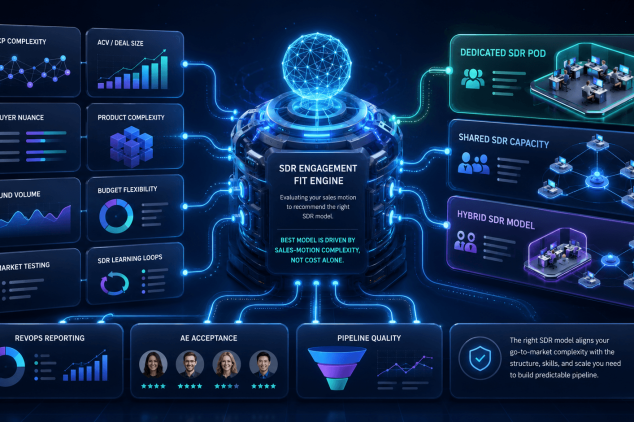
Choose a hybrid model if:
A hybrid model can work when you want dedicated strategy with shared execution support.
Example:
- Dedicated strategist
- Shared SDR execution
- Dedicated RevOps reporting
- Shared list building
- Dedicated weekly review
This can be useful for teams between early testing and full-scale outbound.
How the model affects messaging
Messaging is where the difference becomes visible.
A dedicated SDR model supports deeper messaging because the rep sees repeated patterns across the same market.
They learn:
- Which openings work
- Which objections repeat
- Which personas respond
- Which accounts are poor fit
- Which pain points convert
- Which follow-ups create meetings
A shared SDR model can still use good messaging, but it may struggle to build the same level of instinct.
That matters because B2B outbound is not just sending words. It is learning how the market reacts.
How the model affects cold calling
Cold calling exposes model quality quickly.
Dedicated SDRs usually have stronger call context because they spend more time inside one market.
Shared SDRs may be faster to deploy but need tighter scripts and stronger management.
For complex cold calling, dedicated is usually safer.
Why?
Because objections are nuanced.
A prospect saying “we already have a vendor” means something different in cybersecurity, RevOps, outsourced SDR, HR tech, and logistics software.
A dedicated rep learns those differences faster.
How the model affects email outreach
Shared SDR models can work well for structured email campaigns if the messaging and segmentation are already built.
But if email performance depends on deeper account context, dedicated usually works better.
Dedicated SDRs or pods are stronger for:
- Persona-specific messaging
- Account-based outreach
- Enterprise target accounts
- Objection-based follow-up
- Trigger-based campaigns
- Segment-level message testing
Shared SDRs are better for:
- Basic follow-up
- Simple offers
- High-level campaign execution
- Early-stage testing
- Standard sequences
How the model affects RevOps and reporting
A dedicated SDR model usually creates cleaner reporting because the account owner is clearer.
That helps with:
- Source attribution
- SDR performance tracking
- Meeting quality review
- Objection analysis
- AE feedback
- Funnel diagnostics
- Campaign optimization
A shared model needs careful RevOps design so performance does not become blurry.
If multiple SDRs touch the same account across multiple campaigns, you need clean CRM rules.
Track:
- Rep owner
- Campaign source
- Sequence name
- Persona
- Objection type
- Meeting booked
- Meeting held
- SQL accepted
- Opportunity created
- Closed-lost reason
Without this, shared SDR performance becomes hard to evaluate.
Pricing: dedicated vs shared SDR models
Most outsourced SDR pricing falls into a few structures:
- Monthly retainer
- Pay per meeting
- Hybrid retainer plus performance
- Project-based campaign
- Dedicated SDR or pod pricing
Current SDR outsourcing guides describe monthly retainers as common for dedicated or shared SDR models, while pay-per-meeting requires careful qualification rules and AE acceptance tracking. (Prospeo)
Dedicated SDR pricing logic
Dedicated models cost more because you are paying for:
- Rep focus
- Manager oversight
- Onboarding
- Market learning
- Campaign development
- Reporting
- Strategic alignment
- Consistent execution
Best judged by:
- SQL quality
- Opportunity creation
- Pipeline value
- AE acceptance
- Learning velocity
Shared SDR pricing logic
Shared models cost less because you are buying partial capacity.
Best judged by:
- Speed to launch
- Early signal
- Cost efficiency
- Meeting volume
- Response quality
- Campaign viability
Do not judge a shared model by the same depth expectations as a dedicated pod.
That is how buyers create unrealistic expectations.
Red flags in either model
Be careful if an outsourced SDR provider:
- Cannot explain who works on your account
- Uses generic scripts for every client
- Does not define qualified meetings
- Reports only activity volume
- Avoids AE feedback
- Has no call review process
- Does not integrate with CRM
- Cannot explain list sourcing
- Promises unrealistic meeting volume
- Treats SDR as a pure volume function
The model matters. But management quality matters more.
Questions to ask before choosing a model
Ask these before signing.
Account ownership
- Who exactly works on our account?
- Are SDRs dedicated, shared, or hybrid?
- How many clients does each SDR support?
- Who manages the SDR?
- Who writes messaging?
- Who builds lists?
Performance management
- How are calls reviewed?
- How often are campaigns optimized?
- How are objections tracked?
- What happens if meeting quality is poor?
- What does the first 90 days look like?
Qualification
- What counts as a qualified meeting?
- How is SQL quality measured?
- What happens if an AE rejects a meeting?
- Do you track meetings held or only meetings booked?
RevOps
- Do you work inside our CRM?
- How do you track source attribution?
- How are leads routed?
- How do you prevent duplicate outreach?
- What reporting is included?
Strategy
- How do you define ICP?
- How do you test messaging?
- How do you decide channel mix?
- How do you adjust based on market feedback?
The first 90 days by model
Dedicated SDR model: first 90 days
Days 1 to 30
Focus:
- ICP onboarding
- Messaging development
- List strategy
- CRM setup
- Initial calls and emails
- Early objection capture
Expected output:
- First replies
- First meetings
- Early market feedback
Days 31 to 60
Focus:
- Messaging iteration
- Objection handling
- Segment refinement
- AE feedback loop
- Meeting quality review
Expected output:
- Better conversion quality
- Clearer persona learnings
- Early SQL data
Days 61 to 90
Focus:
- Pipeline validation
- Opportunity tracking
- Scale decision
- Account strategy refinement
Expected output:
- Better view of pipeline potential
- Decision to scale, adjust, or pause
Shared SDR model: first 90 days
Days 1 to 30
Focus:
- Quick campaign setup
- Basic ICP validation
- Early outreach
- Response testing
Expected output:
- Early replies
- Early objection patterns
- Initial market signal
Days 31 to 60
Focus:
- Refine messaging
- Remove poor-fit segments
- Improve call and email scripts
- Tighten follow-up
Expected output:
- Better response quality
- Clearer sense of fit
Days 61 to 90
Focus:
- Decide whether to continue, scale, or move into dedicated model
Expected output:
- Evidence for whether the market deserves deeper investment
The practical answer: which model should you choose?
Choose the dedicated SDR model if sales development is a serious pipeline channel for your company.
Choose the shared SDR model if you need lighter coverage, early signal, or cost-efficient testing.
Choose a hybrid model if you need strategic ownership but are not ready for a full dedicated SDR pod.
The best outsourced SDR engagement model is the one that matches your sales motion, not the one that sounds most efficient on paper.
Trust note
This guide is based on a practical sales development operating view: ICP complexity, ACV, SDR ramp, account context, qualification standards, AE handoff, RevOps reporting, and pipeline quality.
The recommendation is not “dedicated is always better.” The recommendation is to match the engagement model to the level of context your buyers require.
That is what protects sales quality.
Where LevelUp Leads fits
LevelUp Leads supports B2B companies that need outsourced sales development tied to targeting, messaging, SDR execution, and qualified pipeline.
For buyers comparing a dedicated SDR team, shared SDR team, or hybrid outsourced SDR engagement model, the right starting point is not headcount.
It is diagnosis:
- How complex is the ICP?
- How much context does the SDR need?
- How much outbound volume is required?
- What qualification standard protects AE time?
- What model creates the best learning loop?
- What reporting is needed to judge pipeline quality?
That is the conversation that should happen before choosing a model.
Conclusion: do not buy SDR capacity before defining SDR complexity
The dedicated SDR model vs shared SDR model decision is not just a budget decision.
It is a sales design decision.
A dedicated model gives you focus, context, learning, and stronger brand representation. A shared model gives you flexibility, lower cost, and faster testing.
Both can work.
Both can fail.
The deciding factor is how much judgment your outbound motion requires.
If your buyer needs nuance, your SDR model needs depth. If your campaign needs early signal, a shared model may be enough. If you are between the two, a hybrid model may be the right bridge.
LevelUp Leads
If you are evaluating outsourced SDR models, LevelUp Leads can help you decide whether a dedicated pod, shared SDR team, or hybrid structure fits your market.
The useful next step is not picking a package. It is mapping your ICP, ACV, sales cycle, messaging complexity, and qualification standard to the right SDR engagement model.