


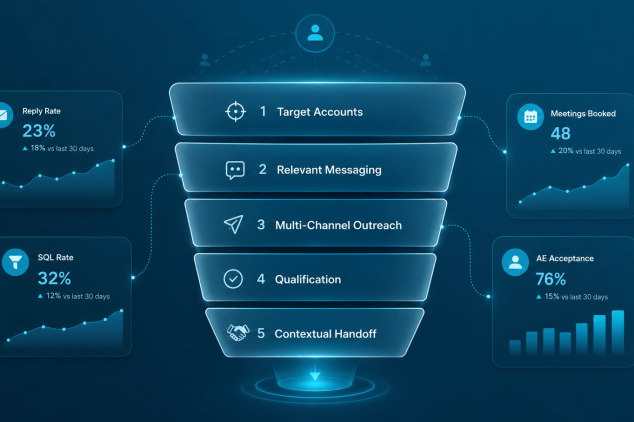
Key Takeaways
An SDR should not be measured only by how much activity they complete. They should be measured by whether that activity creates sales-accepted pipeline.
A strong SDR does not just send emails, make calls, and book meetings. A strong SDR understands the ICP, prioritizes accounts, creates relevant outreach, handles objections, qualifies carefully, and gives AEs enough context to run a useful discovery call.
That matters because B2B prospecting has moved away from a pure volume game. Modern outbound teams are increasingly using ICP definition, buying signals, account intelligence, and multichannel outreach to prioritize the right accounts instead of blasting static lists.
What is an SDR?
An SDR, or sales development representative, is responsible for identifying, contacting, qualifying, and creating sales opportunities with potential buyers.
In B2B sales, SDRs usually handle:
- Outbound prospecting
- Inbound lead follow-up
- Cold email
- Cold calling
- LinkedIn outreach
- Account research
- Lead qualification
- Meeting booking
- CRM updates
- AE handoff
- Objection documentation
The SDR sits between market interest and sales opportunity. That makes the role operationally important. Poor SDR execution creates noise. Strong SDR execution creates pipeline clarity.
Why SDR best practices matter
SDR best practices matter because sales development is where strategy becomes market contact.
A company can have a good product, strong website, and decent demand generation. But if SDRs target the wrong accounts, use weak messaging, qualify loosely, or hand off poor context, pipeline quality suffers.
Good SDR practice improves:
- Positive reply rate
- Conversation quality
- Meeting held rate
- SQL rate
- AE acceptance
- Opportunity creation
- Pipeline reliability
- Closed-lost learning
- GTM feedback loops
The goal is not just more meetings.
The goal is better meetings.
1. Start with a clear ICP
The first SDR best practice is ICP discipline.
SDRs should know exactly which accounts are worth working and which accounts should be avoided.
A weak ICP:
“B2B companies that need more leads.”
A better ICP:
“US-based B2B SaaS companies with 50 to 500 employees, at least five AEs, HubSpot or Salesforce in place, and pressure to improve outbound meeting quality.”
A strong ICP helps SDRs decide:
- Which accounts to prioritize
- Which personas to contact
- Which pain points to lead with
- Which triggers matter
- Which accounts to disqualify
The fix:
Give SDRs account tiers.
- Tier 1: Best-fit accounts with clear trigger signals
- Tier 2: Good-fit accounts without urgent signals
- Tier 3: Low-fit or excluded accounts
This prevents spray and pray prospecting.
2. Prioritize accounts before contacts
Weak SDR workflows start with contact lists.
Strong SDR workflows start with account strategy.
Before contacting a prospect, the SDR should know:
- Why this account?
- Why this persona?
- Why now?
- What problem might they care about?
- What signal suggests relevance?
- What would make this account unqualified?
This is especially important for B2B SaaS, enterprise sales, and complex outbound.
Modern prospecting guidance increasingly frames effective outreach around account intelligence, buying signals, and timing, not just large contact databases. (Salesmotion)
3. Use buying signals, not random timing
A buying signal is a clue that an account may be more likely to care now.
Examples:
- New funding
- New executive hire
- SDR or AE hiring
- Market expansion
- New product launch
- CRM migration
- Website traffic spike
- Webinar attendance
- Competitor change
- Vendor renewal window
- Compliance pressure
- Job posts mentioning relevant tools
Signal-based prospecting gives SDRs a better reason to reach out.
Weak opener:
“Just checking whether improving outbound is a priority.”
Stronger opener:
“Noticed your team is hiring three AEs. When sales capacity grows faster than qualified pipeline, teams often need to tighten account selection and SDR qualification.”
This is more relevant because it connects a signal to a business problem.
4. Build messages around business problems
Most weak SDR outreach leads with the offer.
Examples:
- “We provide outsourced SDRs.”
- “We offer AI sales automation.”
- “We help companies generate leads.”
- “We book qualified meetings.”
That is feature-led messaging.
Problem-led messaging starts with what the buyer is dealing with.
Example:
“Many B2B sales teams are increasing SDR activity, but still seeing AEs reject meetings because ICP fit and qualification are loose.”
This creates a better conversation because it names a recognizable problem.
The rule:
Do not personalize to prove you researched. Personalize to prove the conversation is relevant.
5. Avoid personalization theater
Personalization theater is outreach that looks customized but does not create business relevance.
Examples:
- “Loved your recent post.”
- “Congrats on the new role.”
- “Saw your company is growing.”
- “Impressed by your mission.”
These lines are not always wrong. They are just weak if they do not connect to a business issue.
Better personalization:
“Noticed your team is expanding into enterprise accounts. That usually creates a different outbound problem: fewer accounts, more stakeholders, and a higher bar for SDR research.”
That is useful because it links context to likely pain.
6. Use multichannel outbound with a clear role for each channel
SDRs should not rely on one channel.
A strong SDR workflow often includes:
- Cold email
- Cold calling
- Voicemail
- CRM tasks
- Follow-up sequences
- AE-assisted outreach for strategic accounts
Each channel should have a job.
|
Channel |
Best use |
|
|
Create written context |
|
Phone |
Diagnose fit and handle objections |
|
|
Build familiarity and validate identity |
|
CRM tasks |
Maintain follow-up discipline |
|
AE touch |
Support strategic accounts |
Multichannel does not mean spamming prospects everywhere. It means using channels intentionally.
7. Write shorter cold emails
Many SDR emails are too long.
A good cold email should usually answer:
- Why this person?
- Why this problem?
- Why now?
- What is the next step?
Example:
Subject: SDR meeting quality
Hi Alex,
Many B2B SaaS teams are increasing SDR activity, but still seeing AEs reject meetings because ICP fit or timing is weak.
Curious if your team is mainly focused on booking more meetings right now, or improving the quality of SDR-sourced pipeline?
Best,
Name
This email is not trying to explain everything. It is trying to earn a reply.
8. Make cold calls problem-led
Cold calling is not dead. Weak cold calling is dead.
A good SDR call opener is specific, calm, and relevant.
Weak opener:
“Hi, we help companies generate more leads. Do you have 30 seconds?”
Better opener:
“Hi Alex, the reason I’m calling is that many SaaS teams are increasing SDR activity but still struggling with meeting quality. Usually the issue is ICP fit, timing, or AE handoff. Is that something your team is dealing with, or not really?”
Why it works:
- It gives a clear reason for the call
- It names a specific problem
- It gives the prospect an easy way to respond
- It avoids sounding like a generic pitch
9. Diagnose objections instead of fighting them
SDRs should not treat every objection as resistance.
Objections are data.
Common objections include:
- “Not interested.”
- “Send me an email.”
- “We already have a vendor.”
- “We do this internally.”
- “No budget.”
- “Not the right person.”
- “Call me later.”
The best response is usually:
- Acknowledge
- Diagnose
- Reframe
- Ask for a small next step
Example:
Prospect: “Not interested.”
SDR: “Totally fair. Is that because this is not a priority right now, or because you already have a team handling it?”
That response helps classify the objection.
10. Qualify for fit, not just interest
Interest is not qualification.
An SDR should qualify for:
- ICP fit
- Correct persona
- Business pain
- Timing
- Buying influence
- Current process
- Urgency
- Next-step clarity
A prospect can be interested and still be a poor use of AE time.
The SDR’s job is to protect the AE calendar.
11. Define what a qualified meeting means
A meeting is not qualified just because someone accepted a calendar invite.
A qualified meeting should usually include:
- Account matches ICP
- Prospect is the right persona or influencer
- Problem is relevant
- Prospect agreed to a business conversation
- SDR documented context
- AE accepts the meeting as useful
If the company does not define qualified meeting criteria, SDRs will optimize for calendar volume.
That is how low-quality appointment setting happens.
12. Improve AE handoff quality
A good AE handoff includes:
- Prospect name, title, and company
- ICP fit notes
- Why the account was targeted
- Pain or trigger mentioned
- Objection history
- Outreach history
- Current vendor or process
- Qualification notes
- Recommended discovery angle
Bad handoff:
“Booked a meeting with VP Sales.”
Better handoff:
“VP Sales at a 200-person SaaS company. Team is hiring AEs and reviewing SDR productivity. Main concern is meeting quality, not volume. Mentioned AEs are rejecting some meetings as poor fit. Recommended angle: ask how they currently define SQL quality and SDR acceptance.”
That handoff helps the AE start stronger.
13. Keep CRM hygiene tight
CRM hygiene is not admin work. It is revenue infrastructure.
SDRs should consistently update:
- Lead status
- Account owner
- Persona
- Source
- Sequence
- Objection
- Meeting outcome
- Qualification notes
- Next step
- Disqualification reason
Without CRM discipline, RevOps cannot tell what is working.
Automation and AI can help with repetitive CRM tasks, call summaries, and follow-up reminders, but teams still need clean process and human judgment. Recent SDR and sales automation guidance emphasizes using AI to reduce repetitive work while keeping reps focused on buyer conversations and qualification. (SalesPro Leads)
14. Use AI for support, not lazy automation
AI can help SDRs with:
- Account research
- Lead enrichment
- Call summaries
- Message drafts
- Objection pattern analysis
- CRM updates
- Follow-up reminders
- Persona research
But AI should not blindly send generic outreach at scale.
Bad AI SDR practice:
- Auto-generating fake personalization
- Sending unreviewed messages
- Scaling weak ICP lists
- Replacing discovery with scripts
- Optimizing for volume over quality
Good AI SDR practice:
- Use AI to prepare the rep
- Use AI to summarize context
- Use AI to identify patterns
- Keep humans responsible for judgment
15. Build an SDR daily workflow
A good SDR workflow protects focus.
Example structure:
Morning: Prioritization
- Review Tier 1 accounts
- Check buying signals
- Prepare call blocks
- Review follow-ups due
- Confirm meetings and no-show risks
Midday: Outreach execution
- Call priority accounts
- Send targeted emails
- Work LinkedIn touches
- Respond to replies
- Book qualified meetings
Afternoon: Follow-up and CRM
- Log objections
- Update lead status
- Send recap emails
- Prepare AE handoffs
- Review next-day priorities
The exact schedule can vary, but the principle stays the same: separate research, execution, and admin so the SDR is not constantly context-switching.
16. Follow up with context
Bad follow-up:
“Just bumping this.”
Better follow-up:
“Following up because the issue is usually not outbound volume. It is whether SDR-sourced meetings are accepted by AEs as real pipeline.”
Follow-up should add context, not repeat the same ask.
Strong follow-up can include:
- A different pain angle
- A short insight
- A relevant question
- A trigger reference
- A recap from a call
- A clear opt-out
17. Know when to disqualify
Great SDRs are not afraid to disqualify.
Disqualify when:
- The account does not match ICP
- The person has no influence
- There is no relevant pain
- Timing is unrealistic
- The use case does not fit
- The prospect is only curious
- There is no clear next step
Disqualification improves pipeline quality.
It also protects SDR capacity.
18. Coach with call recordings and reply analysis
SDR managers should review:
- Call openers
- Objection handling
- Talk time
- Question quality
- Tone
- Follow-up quality
- Email replies
- Meeting outcomes
- AE feedback
Do not only coach activity.
Coach judgment.
The best coaching question is not “Did the rep follow the script?”
It is:
Did the rep create a relevant business conversation with the right buyer?
19. Track the right SDR metrics
Activity matters, but it is not enough.
Track:
Activity metrics
- Calls made
- Emails sent
- LinkedIn touches
- Accounts worked
- Follow-ups completed
Engagement metrics
- Contact rate
- Positive reply rate
- Conversation rate
- Meeting booked rate
Quality metrics
- Meeting held rate
- SQL rate
- AE acceptance rate
- Opportunity creation
- Pipeline generated
SDR benchmark content often distinguishes activity metrics from outcome metrics because raw activity can hide poor conversion or low-quality meetings. (Prospeo)
The key is to measure both execution and quality.
20. Build feedback loops with AEs
SDRs and AEs should not operate in separate worlds.
AEs should tell SDRs:
- Which meetings were strong
- Which meetings were weak
- Which objections appeared
- Which accounts progressed
- Which personas were wrong
- Which pain points were real
- Which notes were missing
SDRs should tell AEs:
- What prospects are saying
- Which messages are working
- Which objections are repeating
- Which accounts are not responding
- Which segments show stronger signal
This improves the whole sales motion.
21. Treat SDR work as market intelligence
Every SDR touch creates learning.
SDRs should capture:
- Objections
- Pain language
- Competitor mentions
- Current vendor
- Timing signals
- Referral paths
- Common misconceptions
- Persona ownership
- Disqualification patterns
This helps marketing, sales, product, and RevOps.
A good SDR team does not only create meetings. It helps the company understand the market.
SDR best practices by role
For SDRs
Focus on:
- Account research
- Relevant outreach
- Clear call openers
- Objection diagnosis
- Consistent follow-up
- CRM hygiene
- Qualified handoff
Do not confuse busyness with performance.
For SDR managers
Focus on:
- ICP discipline
- Coaching
- Call review
- Message testing
- Quality metrics
- AE feedback
- Rep enablement
Do not manage only by activity volume.
For founders
Focus on:
- Founder-led learning before scaling
- Clear ICP
- Message-market fit
- Direct customer conversations
- Qualification standards
- Repeatable process
Do not hire SDRs to solve unclear positioning.
For RevOps
Focus on:
- Lifecycle stages
- Source attribution
- CRM fields
- Dashboards
- Lead routing
- SLA tracking
- Opportunity conversion
Do not let the SDR funnel become a reporting blind spot.
Common SDR mistakes
Mistake 1: Prospecting into a broad list
The fix:
Prioritize accounts by ICP fit and buying signals.
Mistake 2: Leading with features
The fix:
Lead with the business problem.
Mistake 3: Sending long emails
The fix:
Keep the first email focused on one pain and one question.
Mistake 4: Treating “send me an email” as progress
The fix:
Ask what would be useful to send, then follow up with context.
Mistake 5: Booking weak meetings
The fix:
Define qualified meeting criteria and use AE feedback.
Mistake 6: Poor CRM notes
The fix:
Treat CRM notes as part of the buyer experience and revenue system.
Mistake 7: Measuring only activity
The fix:
Track SQLs, AE acceptance, and opportunity creation.
SDR best practices checklist
Use this checklist weekly.
ICP and accounts
- Target accounts match ICP.
- Accounts are tiered.
- Personas are mapped.
- Buying signals are reviewed.
- Disqualifiers are clear.
Messaging
- Outreach starts with buyer pain.
- Emails are short.
- Call openers are relevant.
- Personalization connects to business context.
- Follow-ups add new context.
Execution
- Calls, emails, and LinkedIn are coordinated.
- Follow-ups are completed on time.
- Objections are logged.
- Replies are categorized.
- Meetings are confirmed.
Qualification
- Prospect matches ICP.
- Pain is relevant.
- Timing is understood.
- Buyer role is clear.
- Next step is specific.
Handoff
- AE receives context.
- CRM fields are complete.
- Objections are documented.
- Meeting reason is clear.
- AE feedback is collected.
Trust note: what this guide is based on
This guide uses a practical sales development operating view: ICP clarity, signal-based account selection, message-market fit, multichannel outreach, qualification, CRM discipline, AE handoff, and pipeline measurement.
The recommendation is not “do more.” The recommendation is “do the right work with enough consistency and quality to create pipeline.”
Where LevelUp Leads fits
LevelUp Leads helps B2B teams build and execute SDR motions focused on qualified conversations, not just activity.
That includes:
- ICP refinement
- Outbound messaging
- Cold email
- Cold calling
- Appointment setting
- SDR workflow
- Objection handling
- Qualification standards
- AE handoff
- Pipeline reporting
The goal is simple: help sales teams create meetings that are more likely to become real opportunities.
Conclusion
The best SDRs create clarity, not just activity
SDR best practices come down to discipline.
Target the right accounts. Lead with buyer pain. Use channels intentionally. Diagnose objections. Qualify carefully. Log clean data. Hand off context. Measure pipeline quality.
The best SDRs do not win because they are louder.
They win because they are more relevant, more consistent, and better at turning market contact into qualified sales conversations.
LevelUP Leads
If your SDR team is generating activity but not enough qualified pipeline, LevelUp Leads can help review the full sales development motion.
A useful starting point is an SDR workflow audit: ICP, messaging, prospecting process, objection handling, qualification standards, and AE handoff.