


Key Takeaways
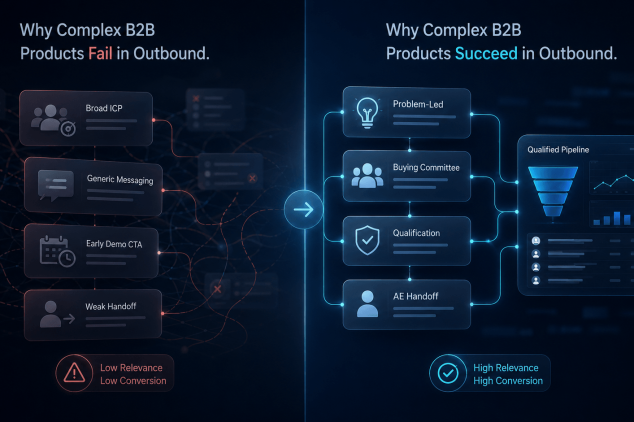
Outbound for complex B2B products fails when teams treat a high-consideration sale like a simple appointment-setting motion.
The product may be strong. The market may be real. The sales team may be capable.
But if the outbound motion compresses a complex business problem into generic SDR messaging, shallow personalization, and a “book a demo” CTA too early, buyers ignore it.
The core issue is simple:
Complex products do not fail in outbound because buyers hate being contacted. They fail because the outreach does not create enough relevance, trust, or business context to justify a conversation.
What makes a B2B product complex?
A complex B2B product is difficult to evaluate, explain, implement, or buy without multiple stakeholders and a clear business case.
Complexity usually comes from one or more factors:
- Long sales cycle
- High ACV
- Multiple decision-makers
- Technical implementation
- Change management
- Compliance or security review
- Integration requirements
- Budget approval process
- Category education
- Internal politics
- Strong status quo
- Hard-to-measure ROI
Examples include:
- Enterprise SaaS
- Cybersecurity platforms
- RevOps and data infrastructure
- AI workflow software
- Healthcare technology
- Fintech platforms
- ERP or CRM systems
- Supply chain software
- Outsourced sales development
- Complex professional services
In these markets, the buyer is not just deciding whether the product is interesting. They are deciding whether the problem is worth prioritizing, whether the risk is acceptable, and whether internal teams will support the change.
That is why simple outbound tactics often break.
Why outbound fails for complex B2B products
1. The message explains the product, not the problem
This is the most common failure.
The outbound message talks about features, capabilities, integrations, AI, automation, dashboards, workflows, or “end-to-end solutions.”
But the buyer is thinking about problems:
- Missed pipeline targets
- Poor forecast accuracy
- Manual reporting
- Security exposure
- Low adoption
- Operational risk
- Slow sales cycles
- Poor handoff between teams
- Wasted AE time
- Failed implementation from a past vendor
Complex outbound works when it starts with the buyer’s active pain, not the product’s architecture.
Weak message
“We are an AI-powered platform that helps revenue teams automate workflows and improve efficiency.”
Better message
“Many RevOps teams are trying to improve forecast accuracy, but the real issue is often inconsistent lifecycle data, poor routing, and manual handoffs between marketing, SDRs, and AEs.”
The second message works better because it names the operational pain before introducing the solution.
2. The ICP is too broad
A broad ICP creates weak outbound.
For complex products, “B2B SaaS companies with 100 to 1,000 employees” is not enough.
A useful ICP should include:
- Company size
- Industry
- Revenue range
- Geography
- Technology stack
- Sales motion
- Maturity stage
- Buying triggers
- Current workflow
- Internal owner
- Disqualifiers
For example:
Weak ICP:
“Enterprise companies that need better data.”
Better ICP:
“US-based B2B SaaS companies with 200 to 1,500 employees, Salesforce in place, multiple GTM teams, inconsistent lifecycle reporting, and RevOps ownership of pipeline attribution.”
That level of specificity improves list quality, messaging, and SDR confidence.
The fix:
Do not scale outbound until the ICP is operationally useful.
3. The SDR is asked to sell too much, too early
A complex product cannot be fully sold in a cold email or 30-second call opener.
The SDR’s job is not to explain every feature. The SDR’s job is to create enough relevance to earn the next conversation.
That means the SDR needs to focus on:
- Problem recognition
- Buyer context
- Trigger relevance
- Initial qualification
- Business pain
- Next-step fit
The AE can handle deeper discovery, technical alignment, business case, procurement risk, and stakeholder mapping.
When SDRs try to explain the full product too early, the message becomes heavy. Buyers disengage.
The fix:
Give SDRs a simple first conversation goal:
Do not sell the platform. Sell the relevance of the problem.
4. The outbound motion ignores the buying committee
Complex B2B purchases are rarely made by one person.
Gartner has reported that B2B buyers increasingly prefer rep-free buying experiences, with a 2026 survey finding 67% of B2B buyers prefer a rep-free experience. That does not mean human sales is irrelevant. It means buyers want more control and more self-directed evaluation before engaging deeply with sales. (Gartner)
For complex products, outreach must account for multiple roles:
- Economic buyer
- Technical evaluator
- Department leader
- End user
- RevOps owner
- Procurement
- Security
- Finance
- Legal
- Executive sponsor
Each person cares about something different.
A CFO may care about cost and risk. A VP Sales may care about pipeline. RevOps may care about workflow and attribution. IT may care about integration and security.
One message will not work for all of them.
The fix:
Build persona-specific outbound angles.
5. The CTA is too aggressive
Many outbound campaigns fail because they ask for too much too soon.
For a complex product, “Want a demo?” is often premature.
The buyer may not yet understand:
- The problem
- The cost of inaction
- Why now matters
- How the solution fits
- Who should be involved
- Whether the risk is worth it
Better CTAs include:
- “Worth comparing notes?”
- “Is this on your radar?”
- “Should this sit with you or RevOps?”
- “Open to a short conversation on how teams are handling this?”
- “Would it be useful to see how others are approaching this?”
The CTA should match the buyer’s awareness stage.
6. Personalization becomes theater
Complex B2B outbound often fails because personalization stays surface-level.
Bad personalization:
- “Saw your LinkedIn post.”
- “Congrats on your growth.”
- “Noticed your company is hiring.”
- “Loved your mission.”
That is personalization theater.
It proves the SDR looked at something. It does not prove the message matters.
Useful personalization connects context to a likely business issue.
Example:
“Noticed your team is hiring enterprise AEs while expanding into healthcare. When sales capacity grows faster than qualified pipeline, outbound often breaks at account selection, compliance-aware messaging, and AE handoff.”
That is better because it links a public signal to a business problem.
The fix:
Personalize for relevance, not decoration.
7. The sales team treats outbound like a volume game
Volume matters. But volume without precision damages complex sales.
Spray and pray tactics are especially risky when:
- The target account list is small
- The buyer group is senior
- The category is trust-sensitive
- The ACV is high
- The product requires education
- The brand needs credibility
Modern outbound strategy sources increasingly criticize old high-volume playbooks and emphasize relevance, trust, and market validation instead of generic cadence blasting.
The fix:
Use volume only after the message, ICP, and qualification standard are working.
8. There is no message-market fit
Message-market fit means the market quickly understands why your message matters.
Complex products often struggle because the product is useful, but the message is unclear.
Symptoms include:
- Low positive reply rate
- Many “not interested” replies
- Prospects misunderstand the offer
- Meetings do not convert to SQLs
- AEs reject SDR-sourced meetings
- Different team members describe the product differently
- The message sounds like every competitor
The fix:
Test messaging by persona, pain point, and trigger. Do not rely on internal opinions.
9. SDRs do not have enough enablement
Complex outbound requires stronger enablement than simple lead generation.
SDRs need:
- ICP definitions
- Persona maps
- Trigger examples
- Competitive context
- Objection handling
- Call openers
- Discovery prompts
- Disqualification rules
- Case studies
- Proof points
- AE handoff templates
- CRM field guidance
If SDRs do not understand the category, they will default to generic messaging.
The fix:
Train SDRs on the business problem, not just the product pitch.
10. The AE handoff is weak
For complex B2B products, the AE handoff is critical.
A calendar invite is not enough.
The AE needs:
- Account context
- Persona and role
- Trigger for outreach
- Pain mentioned
- Objections raised
- Existing vendor or process
- Buying stage
- Stakeholders mentioned
- Qualification notes
- Recommended angle for discovery
Without this, the AE starts from zero and the buyer has to repeat themselves.
The fix:
Treat handoff quality as part of pipeline quality.
Why complex B2B outbound requires a different strategy
Simple outbound asks:
“How do we book more meetings?”
Complex outbound asks:
“How do we create the right conversation with the right account at the right time?”
That requires a different operating model.
The complex B2B outbound framework
Step 1: Define the buying problem
Before writing outreach, define the problem in buyer language.
Ask:
- What pain does the buyer already recognize?
- What is the business impact?
- Who owns the problem?
- What happens if they do nothing?
- What triggers urgency?
- What current workaround exists?
- Why would they change now?
If you cannot answer these clearly, the outreach will sound like a product pitch.
Step 2: Segment the ICP by situation
Do not only segment by firmographics.
Segment by business situation.
Examples:
- Hiring SDRs or AEs
- Expanding into enterprise
- Replacing a legacy system
- Migrating CRM
- Opening a new market
- Raising funding
- Missing pipeline targets
- Consolidating vendors
- Undergoing compliance pressure
- Scaling customer success
- Launching a new product line
Situation-based targeting makes outbound more relevant.
Step 3: Map the buying committee
For each target account, identify:
- Who feels the pain?
- Who owns the budget?
- Who influences the decision?
- Who blocks the decision?
- Who evaluates technical risk?
- Who uses the product daily?
- Who signs the contract?
Then build different messages for different roles.
Step 4: Build a problem-led message
The message should follow this structure:
- Account or market context
- Specific business problem
- Business impact
- Credible reason to talk
- Low-friction next step
Example:
“Many enterprise RevOps teams are trying to increase pipeline visibility, but lifecycle data often breaks between marketing, SDR, and AE handoff. That makes it hard to trust source reporting and forecast coverage. Worth comparing how your team is handling this?”
This is not flashy. It is clear.
Step 5: Use multichannel sequencing
Complex buyers need more context than one email.
Use:
- Email for written relevance
- Phone for live diagnosis
- LinkedIn for familiarity
- Content for education
- Retargeting for reinforcement
- Direct mail or events for strategic accounts
- AE follow-up for deeper conversations
Outbound for complex B2B products is not one touch. It is a coordinated sequence.
Step 6: Qualify for business fit, not just interest
A prospect can be interested and still not qualified.
For complex sales, qualify:
- ICP fit
- Persona relevance
- Problem awareness
- Business impact
- Current process
- Urgency
- Stakeholders
- Budget path
- Technical fit
- Next-step clarity
Do not pass every interested prospect to an AE.
The SDR should protect AE time.
Step 7: Create a feedback loop
Complex outbound improves through market feedback.
Review:
- Objections
- Reply quality
- Call notes
- Meeting held rate
- SQL rate
- AE acceptance
- Opportunity conversion
- Closed-lost reasons
- Segment performance
- Persona performance
RevOps should help connect outbound activity to pipeline outcomes.
Common outbound failure patterns for complex B2B products
Failure pattern 1: Product-first messaging
The email explains the solution before proving the problem matters.
The fix:
Lead with pain, not product.
Failure pattern 2: One-size-fits-all persona messaging
The same message goes to the CFO, VP Sales, RevOps leader, and technical evaluator.
The fix:
Create persona-specific angles.
Failure pattern 3: Overloaded cold emails
The SDR tries to explain everything in one message.
The fix:
Make the first message narrow enough to earn a reply.
Failure pattern 4: Weak account selection
The team contacts companies that technically match firmographics but lack the actual pain.
The fix:
Use triggers and operational indicators, not just company size.
Failure pattern 5: No objection intelligence
Reps hear objections but do not document them.
The fix:
Track objections by persona, segment, and sequence step.
Failure pattern 6: Meetings booked too early
The SDR books meetings before confirming problem relevance.
The fix:
Define qualification standards before launch.
Failure pattern 7: No buyer education layer
The outbound motion assumes the buyer already understands the category.
The fix:
Use content, proof, and follow-up to educate without overwhelming.
Metrics that matter for complex B2B outbound
Do not judge complex outbound only by meetings booked.
Track:
Activity metrics
- Emails sent
- Calls made
- LinkedIn touches
- Accounts worked
- Contacts reached
Engagement metrics
- Reply rate
- Positive reply rate
- Call connect rate
- Conversation rate
- Follow-up response rate
Quality metrics
- Meeting held rate
- SQL rate
- AE acceptance rate
- Opportunity creation
- Pipeline value
- Sales cycle progression
- Closed-lost reasons
Learning metrics
- Best-performing personas
- Best-performing triggers
- Most common objections
- Segment-level conversion
- Message angle performance
- Buying committee patterns
For complex B2B products, learning velocity is a real performance metric.
How to know if outbound is failing because of the product or the motion
Sometimes outbound fails because the market is not ready. But often, the motion is the issue.
Use this diagnostic.
It may be a product or market issue if:
- Multiple channels fail after strong testing
- Buyers understand the message but do not care
- Pain is weak or low priority
- No persona owns the problem
- There is no budget path
- Customers churn after buying
- Sales conversations reveal no urgency
It may be an outbound motion issue if:
- Buyers misunderstand the offer
- Response improves by segment
- Some personas respond much better than others
- AEs say meetings are poorly qualified
- Objections reveal message confusion
- High-fit accounts are not being targeted
- The message changes too often or not enough
- SDRs cannot explain the problem clearly
Do not conclude “outbound does not work” until you inspect ICP, messaging, sequencing, and qualification.
The role of AI in outbound for complex B2B products
AI can help, but it should not replace GTM judgment.
Useful AI applications:
- Account research summaries
- Buying trigger detection
- CRM hygiene
- Call transcript analysis
- Objection pattern mining
- Message variation drafts
- Persona research
- List enrichment
- Follow-up reminders
Risky AI applications:
- Fully automated outreach to strategic accounts
- Unreviewed personalization
- Generic AI-written sequences
- Automated qualification without human oversight
- High-volume messaging to senior buyers
AI can improve speed. It cannot fix unclear positioning.
Trust note: why this guidance is different
This article does not assume outbound failure is caused by lazy SDRs or bad deliverability alone.
For complex B2B products, failure is usually systemic.
It sits across:
- ICP design
- Buyer understanding
- Message-market fit
- SDR enablement
- Channel sequencing
- Qualification
- AE handoff
- RevOps reporting
That is why the fix must be operational, not just cosmetic.
Where LevelUp Leads fits
LevelUp Leads works with B2B teams that need outbound to create qualified pipeline, not just activity.
For complex products, that means building the outbound motion around:
- Clear ICP
- Persona-specific messaging
- Business pain
- Buying triggers
- Multichannel outreach
- SDR coaching
- Qualification standards
- AE-ready handoff
- Feedback loops tied to pipeline quality
The goal is not to make complex products sound simple. The goal is to make the buying problem clear enough that the right prospect wants to continue the conversation.
Conclusion:
Complex products need problem-led outbound
Outbound for complex B2B products fails when teams force a nuanced sale into a generic prospecting machine.
The fix is not just more emails, more calls, or more automation.
The fix is better sales design:
- Sharper ICP
- Clearer pain
- Better persona mapping
- Stronger message-market fit
- More useful CTAs
- Better SDR enablement
- Cleaner AE handoff
- Stronger RevOps feedback
Complex products can work in outbound. But they need outbound built around how complex buyers actually evaluate risk, priority, and change.