
The True Cost of an In-House SDR at a Glance
A US-based in-house Sales Development Representative (SDR) costs roughly $120,000 to $180,000+ per year once compensation, benefits, recruiting, training, tools, equipment, management time, and turnover are counted. That is about 2 to 3 times the $58,000 to $65,000 base salary most hiring budgets start with.
The estimates below are based on 2025 US market data and industry averages. They vary by region, industry, company size, and seniority. “Annual cost” means the employer’s fully loaded cost for one SDR seat, not the SDR’s take-home pay.
| Cost Component | Estimated Annual Cost per SDR | What It Covers |
|---|---|---|
| Base salary + variable pay | $68,000 – $90,000 | Base salary of $58,000 – $65,000 plus $10,000 – $25,000 in commission or bonus at target |
| Benefits and payroll taxes | $15,000 – $30,000 | Employer health insurance, 401(k) match, FICA, FUTA, SUTA, and other benefits |
| Recruiting | $5,000 – $15,000 | Agency fees, job boards, sourcing tools, and interview time, annualized over expected tenure |
| Onboarding and training | $3,000 – $7,000 | Leadership and team hours spent training, plus training materials |
| Tech stack and data | $6,700 – $18,250 | CRM, sales engagement platform, prospecting data, and communication tools |
| Equipment and office space | $1,500 – $4,000 | Laptop, monitor, headset, chair, and a prorated desk where applicable |
| Management overhead | $10,000 – $20,000 | Prorated manager time for 1:1s, call reviews, coaching, and reporting |
| Turnover and vacancy | $10,000 – $30,000+ | Re-recruiting, re-training, and lost pipeline while a seat is empty or ramping |
| Total | $120,000 – $180,000+ | Fully loaded annual cost of one in-house SDR seat |
The low end of each line adds up to about $120,000. The high ends add up to more than $200,000, so $180,000 is a typical upper estimate, not a ceiling. Ramp time is not a separate line in this table. It shows up as salary and benefits paid during months when the SDR produces little pipeline.
Line-by-Line Breakdown of In-House SDR Costs
Salary is the only cost most teams see on the offer letter. The rest sits in HR, finance, RevOps, and sales leadership budgets, which is why the full figure is easy to underestimate.
Compensation: base salary is the smallest surprise
SDR pay usually combines a base salary with variable pay tied to meetings or pipeline. Based on 2025 US estimates, base salary runs $58,000 to $65,000, variable pay at target adds $10,000 to $25,000, and total cash compensation lands between $68,000 and $90,000.
The variable portion is not optional once the plan is set. A rep who hits quota earns it, and a rep who misses quota for several months usually becomes a retention or replacement problem.
Benefits and payroll taxes
Every employee carries employer costs on top of cash pay:
- Health insurance (employer portion): $8,000 – $15,000 per year.
- 401(k) match, if offered: $2,000 – $5,000 per year.
- Payroll taxes (FICA, FUTA, SUTA): $5,000 – $8,000 per year.
- Other benefits: PTO, life and disability insurance, and wellness programs, which vary by company.
Together, these add $15,000 to $30,000 per SDR per year.
Recruiting and hiring
A recruiting agency typically charges 15% to 30% of first-year base salary. On a $58,000 to $65,000 base, that is $8,700 to $19,500 per hire. Job boards, applicant tracking, and sourcing tools add $1,000 to $3,000 per hire.
Internal time is the cost few budgets record. HR screens resumes, sales managers run interviews and role plays, and leaders review finalists. Spread across the expected tenure of the hire, recruiting averages $5,000 to $15,000 per SDR per year.
The calendar matters as much as the invoice. SHRM’s recruiting benchmark puts median time-to-fill for nonexecutive roles at 39 calendar days, and that clock runs before training even starts.
Onboarding, training, and ramp
A new SDR needs product training, ICP and messaging deep dives, objection handling practice, and tool setup before the first call. Senior AEs, marketing, and sales leaders usually deliver that training, which takes them away from closing and campaign work. That time is worth an estimated $3,000 to $7,000 per hire.
Ramp is the larger cost. The Bridge Group’s 2025 SDR study reported an average SDR ramp time of 3 months across 351 B2B companies, and many teams plan for 3 to 6 months. During ramp, the company pays full salary, benefits, and software for partial output.
Tech stack and data
Each SDR seat needs its own licenses:
- CRM (for example, Salesforce or HubSpot): $1,000 – $2,000 per year.
- Sales engagement platform (for example, Outreach or Salesloft): $500 – $750 per year.
- Prospecting and contact data (for example, ZoomInfo, Apollo, or Lusha): $5,000 – $15,000 per year.
- Communication tools (for example, Slack, Zoom, or Calendly): $200 – $500 per year.
That totals $6,700 to $18,250 per SDR per year. Many of these tools require annual commitments, so the cost continues when a seat sits empty. Dialers, email verification, and deliverability infrastructure can add more.
Equipment and office space
Hardware such as a laptop, monitor, headset, and chair costs $1,000 to $2,000, amortized over its useful life. Where SDRs work from an office, a desk adds $3,000 to $6,000 per year. Annualized, that comes to $1,500 to $4,000 per SDR.
Management overhead
SDRs need frequent coaching: weekly 1:1s, call reviews, email reviews, playbook updates, and KPI tracking. A typical ratio is 1 manager for every 5 to 8 SDRs. A conservative estimate of the prorated management cost is $10,000 to $20,000 per SDR per year.
Teams with only one or two SDRs often skip a dedicated manager. The coaching then falls to a sales leader or senior AE, so the cost moves from payroll to lost selling time.
Turnover and vacancy
SDR tenure is short. Reps are promoted, leave for other roles, or are let go, and each departure restarts recruiting, onboarding, and ramp. Turnover-related cost runs an estimated $10,000 to $30,000+ per SDR per year.
The largest part of that cost is lost pipeline. An empty or ramping seat can produce few qualified meetings for 3 to 6 months while the company keeps paying for its tools. Account executives who depend on SDR meetings also lose forecast reliability during the gap.
Cost per Qualified Meeting: In-House vs. Outsourced
Annual cost only becomes useful when it is divided by output. Cost per qualified meeting compares both models on the same denominator.
An outsourced SDR typically costs $60,000 to $100,000 per year, with salary, benefits, recruiting, training, tools, management, and turnover included in the agency fee. The range depends on dedicated versus shared capacity, location, and contract length. For reference, LevelUp Leads packages start at $5,000 per month.
Worked example: the same output target, two cost bases
This illustrative model assumes each SDR produces 10 qualified meetings per month once ramped:
| Assumption or Result | In-House SDR | Outsourced SDR |
|---|---|---|
| Annual cost (mid-range estimate) | $150,000 | $80,000 |
| Ramp period | 3 months | 1 month |
| Productive months in year 1 | 9 | 11 |
| Qualified meetings in year 1 | 10 × 9 = 90 | 10 × 11 = 110 |
| Cost per qualified meeting | $150,000 ÷ 90 = $1,667 | $80,000 ÷ 110 = $727 |
In this example, each in-house meeting costs about 129% more than an outsourced meeting, and the in-house seat produces 20 fewer meetings in year 1 because of the longer ramp.
What changes the math
The example holds output constant to isolate cost. Real programs differ, so test these assumptions with your own numbers:
- Meeting output: a strong in-house rep in a well-defined market may outperform 10 meetings per month, and a weak partner may fall short of it.
- Meeting quality: compare AE-accepted meetings and opportunities, not booked meetings alone.
- Tenure: recruiting and ramp costs fall per year when an in-house SDR stays longer.
- Management coverage: a company that already has an SDR manager with spare capacity carries less incremental overhead.
- Internal time on an outsourced program: someone still has to approve messaging, answer questions, and follow up on meetings.
For a deeper comparison of total cost of ownership and ROI, read Outsourced SDR vs In-House SDR: Cost and ROI Analysis. To compare vendor proposals line by line, use the B2B Lead Generation and Outsourced SDR Pricing Guide, or model your own funnel with the Outbound ROI Calculator.
What stays with your team when you outsource
Outsourcing moves recruiting, training, tools, and day-to-day SDR management to the partner. It does not remove every internal responsibility. Your team still owns:
- The ICP, target accounts, and exclusions.
- Messaging approval and product knowledge.
- The definition of a qualified meeting.
- AE follow-up, discovery, and closing.
- CRM rules and pipeline reporting.
A partner that cannot work within those controls will raise your cost per accepted meeting, whatever its monthly fee.
How to Decide Whether to Build, Outsource, or Run Both
Neither model is right for every company. The better choice depends on how proven your outbound motion is, whether you have SDR management capacity, and how quickly you need qualified pipeline.
When building in-house makes sense
- The outbound motion is proven, and you know which ICP, messages, and channels produce accepted meetings.
- You have an experienced SDR manager with capacity to recruit, coach, and report.
- The product requires deep technical knowledge that takes months to learn.
- You plan to grow SDRs into AE roles as part of a long-term talent pipeline.
When outsourcing makes sense
- You need qualified meetings within weeks rather than after a hiring and ramp cycle.
- You have no SDR manager, or your sales leaders cannot spare coaching time.
- You want to test a new segment, vertical, or geography before committing headcount.
- You want SDR capacity as a variable cost that can scale up or down.
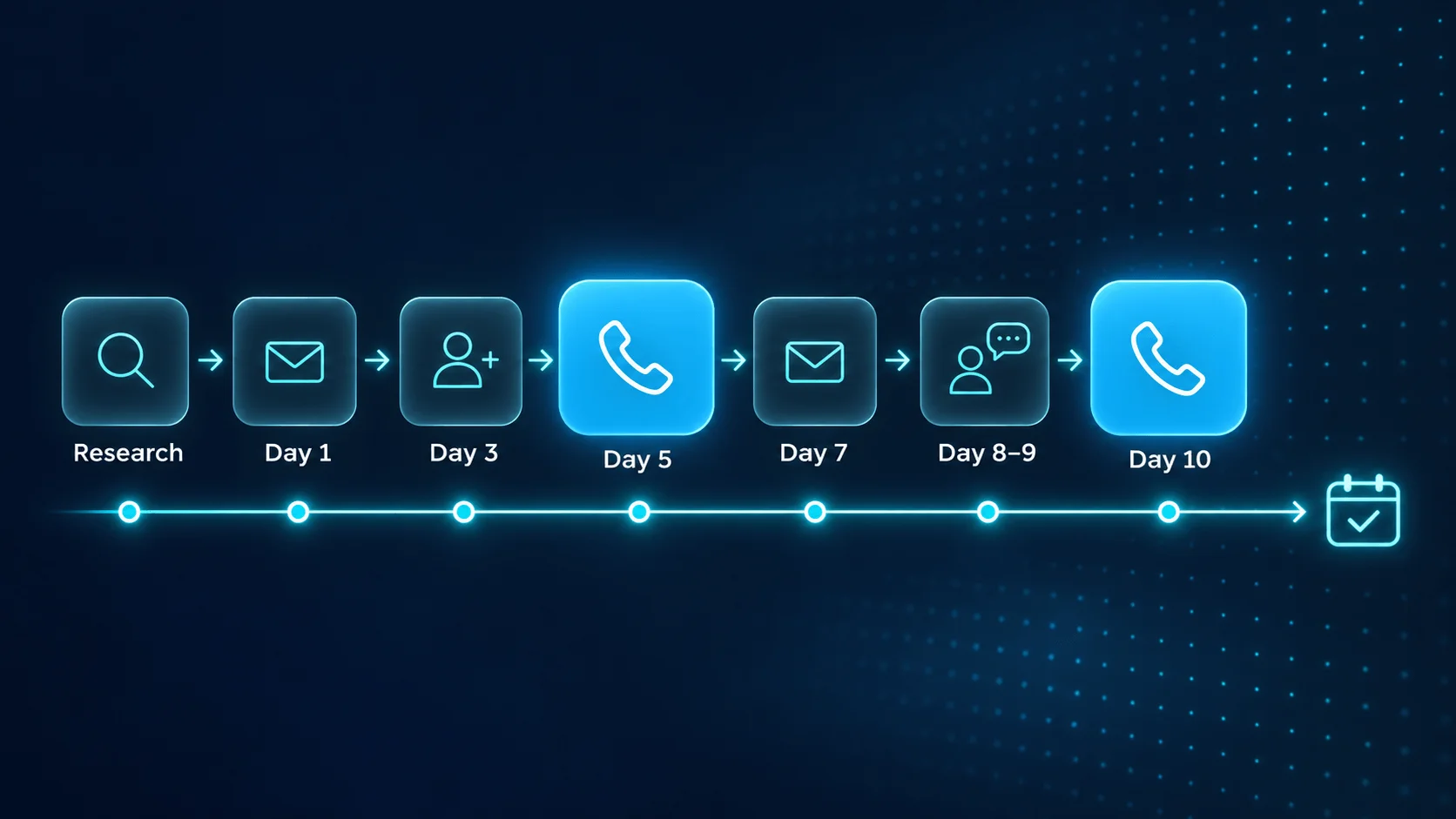
LevelUp Leads offers several ways to do this. An outsourced SDR team runs the full outbound function, from research and list building through qualification and handoff. A fractional SDR adds capacity alongside an existing team. Teams that need a specific channel can use appointment setting, cold calling services, or email outreach, supported by list building and GTM strategy and engineering. Onboarding is not billed, and the first campaign typically launches 7 to 10 days after the onboarding call.
Many companies run both models. A small in-house team handles strategic accounts or inbound follow-up, while an outsourced team covers outbound volume and market testing.
Questions to ask before you choose a partner
A lower monthly fee only saves money if the partner produces meetings your AEs accept. Ask:
- How do you define a qualified meeting, and can we agree on that definition in writing?
- What does onboarding include before the first call?
- Which channels do you run, and how do you build and verify contact lists?
- Can we hear call recordings and review emails sent on our behalf?
- Which metrics do you report beyond meetings booked, and how often do we review them?
- Are tools, data, and onboarding included in the fee, or billed separately?
- What is the initial commitment, and what happens after it ends?
- Can you share case studies from companies with a similar ICP or sales cycle?
Want to see what an outsourced SDR program would cost for your ICP? Schedule a call with LevelUp Leads.
Bonus: The True Cost of Hiring SDRs In-House vs. Outsourcing (free ebook)
Want the complete picture? Our free ebook goes deeper than this article: what the SDR role really involves in a modern GTM motion, what happens step by step when you build in-house, the strategic advantages of outsourcing beyond cost, how to handle the most common objections, and a full checklist for choosing the right partner.
FAQ
A US-based in-house SDR typically costs $120,000 to $180,000+ per year once salary, variable pay, benefits, payroll taxes, recruiting, training, tools, equipment, management time, and turnover are included. Base salary alone usually runs $58,000 to $65,000, so the fully loaded cost is about 2 to 3 times the salary line.