
Why Booking More Discovery Calls Doesn’t Have to Mean Hiring More Reps
Most sales leaders treat meeting volume as a headcount equation: more discovery calls means more reps. The real constraint is usually process, targeting, and channel discipline, not capacity. This article gives you a framework built on four levers: intent data, ICP targeting, coordinated multi-channel outreach, and outsourcing. Together they scale meeting volume without a hiring cycle.
Before you post a job req, ask the questions Knock AI uses to frame the problem: Are qualified buyers reaching your sales team fast enough? Are SDRs spending time on admin instead of selling? Are meetings lost to process rather than people? LevelUp Leads is a full-service and fractional SDR partner that builds pipeline through multi-channel outbound (Email, LinkedIn, Cold Calling), and the answers to those questions usually point to a fix that has nothing to do with adding people.
Schedule a call to see where your outbound process is losing meetings.
Diagnose Whether You Have a Capacity Problem or a Process Problem
More reps only helps if capacity is actually the bottleneck. Often it is not. Run this diagnostic before you conclude you need more headcount.
Ask yourself:
- Do AEs accept the meetings your SDRs book, or do they cancel and complain about fit?
- Are SDRs spending most of their day on research, list-building, and CRM cleanup instead of outreach?
- Where in the funnel are qualified buyers getting lost, at first touch, at reply, or at handoff?
Knock AI makes the point plainly: understanding where the leaks occur is often the fastest way to increase meetings without hiring. A team that adds reps to cover a broken process just scales the waste.
VAEKST Group frames the alternative. To scale B2B sales without immediately hiring, improve the productivity of the team already in place. That means clearer enablement, removing low-value work through automation, and using CRM data to prioritize the opportunities with the strongest commercial potential.
Compare the two approaches.
A weak team adds reps to cover more accounts. It spreads the same untargeted list across more people and calls it growth.
A strong team fixes targeting and process first. It works fewer, better accounts with sharper messaging, then adds capacity only when the motion is proven.
Diagnose your bottleneck before you buy a solution for it. The rest of this article assumes you have found a process problem, because most teams do.
Five Levers to Book More Sales Meetings Without Adding Headcount
Lever 1: Use Intent Data and Buying Signals to Prioritize Outreach
Signal-based selling is the practice of using relevant business events, behaviors, or changes to guide outbound outreach. Instead of contacting prospects at random, you prioritize accounts based on signals that suggest a company may be more open to a conversation.
Concrete signal types worth building around:
- Hiring for specific roles that imply a new initiative or gap
- Funding rounds that free up budget
- Leadership changes that reset priorities
- Market or geographic expansion
- Content engagement, like a pricing-page visit
- Technology or operations changes that create new needs
The signal should guide the message, not dominate it. A funding round is not a reason to reach out on its own. The reason is the business implication behind it: new budget, new hires, new pressure to show results. Connect the signal to a likely pain, and the outreach earns a reply.
Signals are strongest layered on top of a precise ICP, not used as a shortcut around it. A trigger event at a company that will never buy from you is noise. A trigger event at a best-fit account is a meeting.
Instantly.ai recommends data-driven targeting using firmographics and trigger events, and acting fast: a signal like a funding announcement or a pricing-page visit should prompt a call within 24 hours. Speed on a fresh signal beats volume on a stale list.
LevelUp Leads builds custom contact lists and runs intent-driven campaigns aligned to each client’s ICP, so the highest-signal accounts get worked first.
Lever 2: Sharpen ICP Targeting So Every Outreach Hits the Right Account
ICP discipline means SDRs and outbound teams know exactly which accounts are worth working and which should be avoided. Per LevelUp Leads’ SDR best practices, this is the first best practice for a reason. Working the wrong accounts wastes every downstream step.
Use account tiering to make the standard concrete:
- Tier 1: Best-fit accounts with clear trigger signals. Work these first, with the most personalized outreach.
- Tier 2: Good-fit accounts without urgent signals. Work these with steady cadences.
- Tier 3: Low-fit or excluded accounts. Do not work these at all.
To build the ICP itself, Instantly.ai recommends an 80/20 approach: identify the 20% of prospects generating 80% of revenue. Run an ABC analysis of your existing customer base, segmenting by revenue, profitability, and strategic value. The patterns in your best customers define who to target next.
Sales AR adds the frame: define your ICP and set SMART goals (specific, measurable, achievable, relevant, time-bound), then add behavioral signals into lead scoring. Firmographic fit gets you the right list. Behavioral scoring tells you who on that list to call today.
LevelUp Leads executes this through ICP-based prospecting and custom contact list-building, so outreach hits the right accounts instead of a broad, low-fit spread.
Lever 3: Run Coordinated Multi-Channel Outreach (Email, LinkedIn, Cold Calling)
Each channel needs a defined role, not random overlap. A strong SDR uses cold email, cold calling, LinkedIn, voicemail, CRM tasks, and follow-up sequences as parts of one plan, each doing a specific job.
Set targets against real benchmarks. LevelUp Leads’ cold email data shows a funnel that averages roughly:
- Open rate: ~42%
- Reply rate: ~3%
- Positive response: ~2%
- Meetings booked: ~1%
- Bounce rate: ~7.5%
Out of 100 emails, about 40 open, 3 reply, 2 express interest, and 1 books a meeting. Treat these as minimum standards. If your campaign falls below them, the problem is the list or the message, not the channel.
The call carries its own structure. LevelUp Leads’ cold call framework runs in sequence: an opener that earns attention, a stated reason for the call, a relevance hook, a discovery question, objection handling, qualification, and a clear next step. A strong call earns attention, creates relevance, diagnoses fit, and asks for a next step.
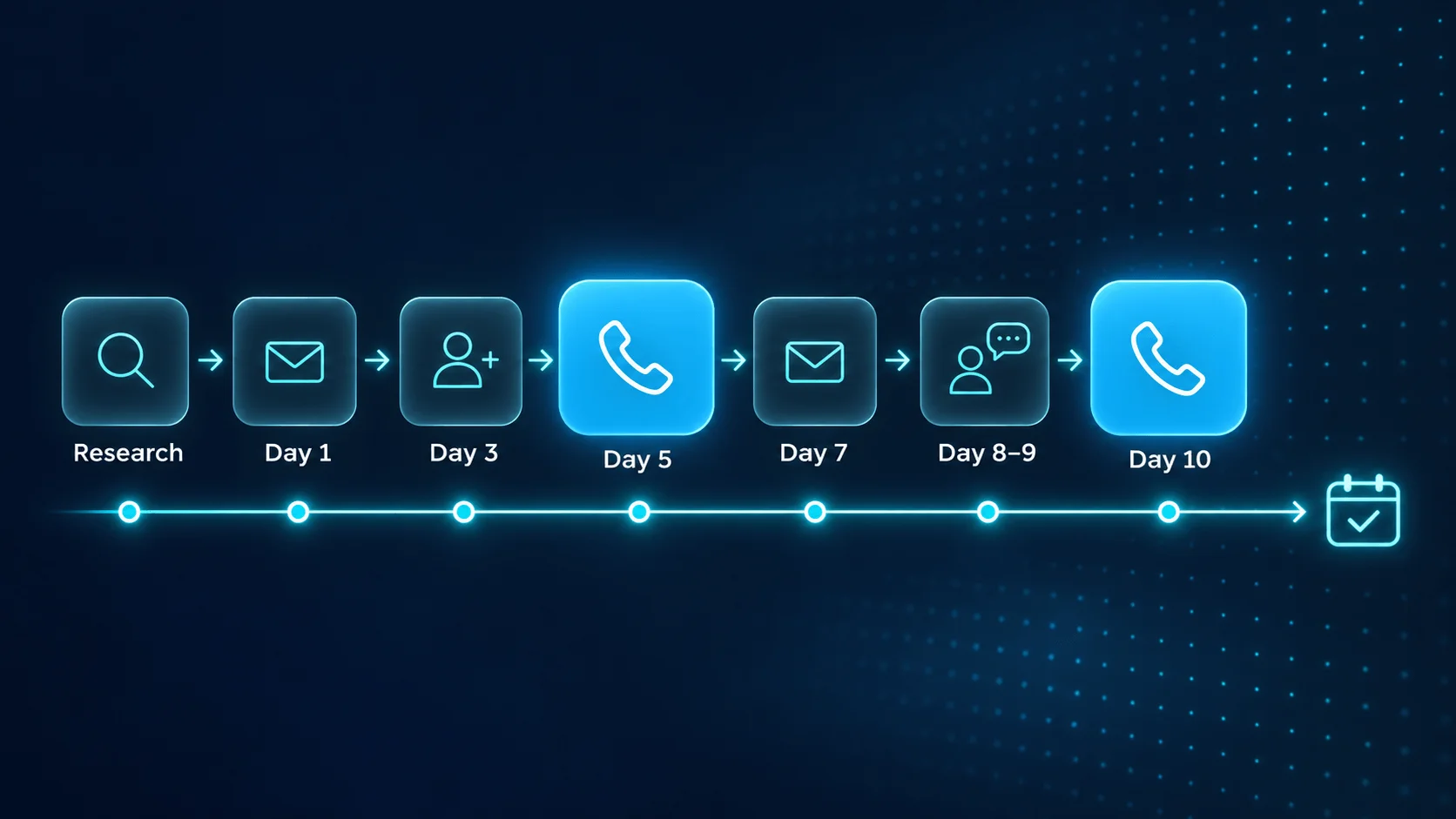
For sequencing, Instantly.ai offers a concrete cadence:
- Day 1: Call plus voicemail
- Day 2: Personalized email
- Day 4: Second call
- Day 6: Value-add email
- Day 9: Third call
- Day 12: Final email
Koncert notes that a multi-channel strategy combining email, calling, social, and voicemail touches prospects more ways, and that dialing automation is 8 to 10 times more cost-effective than manual dialing. More coverage per prospect, at lower cost per touch.
LevelUp Leads runs these coordinated cold calling, email, and LinkedIn programs to build pipeline for each client.
Lever 4: Qualify Harder So Every Booked Meeting Is Actually Worth Holding
A qualified meeting requires ICP fit, the correct persona, relevant business pain, agreement to a real business conversation, documented context, and AE acceptance, per LevelUp Leads’ SDR best practices. An accepted calendar invite that meets none of those is a slot on the calendar, not pipeline.
Consider how two teams handle this differently.
A weak outsourced team sells activity: dials, opens, and calendar invites. The numbers look busy and the pipeline stays empty.
A strong partner protects meeting quality. It books fewer meetings that AEs actually want to hold.
Qualification criteria to apply before booking:
- ICP fit
- Correct persona
- Business pain
- Timing
- Buying influence
- Current process
- Urgency
- Next-step clarity
The AE handoff is where a qualified meeting proves itself. A good handoff includes the name, title, and company, ICP fit notes, why the account was targeted, the pain or trigger, objection history, outreach history, current vendor, qualification notes, and a recommended discovery angle. That context is what separates a meeting the AE closes from one they cancel.
Disqualification discipline matters as much. Know when to say no. If the account does not match the ICP, the contact has no influence, there is no relevant pain, or the timing is unrealistic, do not book it. Booking anything that will hold a calendar slot burns AE time and drops close rates.
Lever 5: Outsource Appointment Setting to Scale Without Adding Headcount
Hiring an SDR looks cheaper than it is. The salary is the visible cost. The hidden costs pile up underneath.
| In-house SDR (hidden costs) | Outsourced appointment setting |
|---|---|
| Recruitment and sourcing time | Faster time-to-impact |
| Onboarding and training | Predictable monthly cost |
| 3 to 6 month ramp before productivity | Built-in management and QA |
| CRM, dialer, and data tool licenses | Scales up or down without re-hiring |
| Data and list-building costs | Dedicated, experienced SDR team |
| Turnover and re-hiring | No PTO or attrition gaps |
| PTO and coverage gaps | Multi-channel execution from day one |
Outsourcing gives you two delivery paths. LevelUp Leads offers both.
Full-service manages the entire outbound process: prospect research, ICP targeting, multi-channel outreach across Email, LinkedIn, and Cold Calling, qualification, and appointment setting. You get a complete function without building one.
Fractional manages outbound strategy, sequencing, and meeting generation to accelerate time-to-first-meeting. It fits teams that have some motion but need speed and expert execution on top.
For companies with no existing motion, LevelUp Leads builds an end-to-end outbound function from zero: lists, playbooks, cadences, scripts, and a dedicated SDR team.
The results are concrete:
- Ammann (first month): 5,530 dials, 401 connects, 209 decision-maker conversations, 11 qualified meetings, and about $30 million in closed-opportunity contribution.
- CoreVest: 224 meetings and over $10 million in qualified pipeline within two months.
- Site 20/20: 240 meetings, 1,895 conversations, and 77,135 dials over six months, with 36.68% of connects becoming conversations.
- Vodafone US IoT: 30 meetings from 882 conversations over five months.
A hybrid setup is an option too. Outsourcing can run alongside a smaller in-house team. Your existing AEs focus on closing while an outsourced SDR partner handles volume prospecting.
Schedule a call to discuss a full-service or fractional engagement.
How LevelUp Leads Books a Qualified Meeting: The Step-by-Step Process
The five levers above become one repeatable motion. Here is how LevelUp Leads runs it.
- ICP and account tiering. Define the ICP, then sort accounts into the tiers described in Lever 2, working best-fit accounts with trigger signals first. This sets what gets worked and in what order.
- Signal and list building. Build custom contact lists and layer in buying signals so the highest-intent Tier 1 accounts surface first. The appointment-setting approach starts by identifying qualified leads through competitive market research and behavioral analysis based on the ICP.
- Multi-channel outreach execution. Run coordinated Email, LinkedIn, and Cold Calling with customized scripts tailored to the target market and value proposition. The SDR day follows a rhythm: morning prioritization, midday outreach execution, afternoon follow-up and CRM work.
- Objection handling and qualification. On the call, follow the cold call framework from Lever 3, which diagnoses fit instead of pitching features.
- AE handoff and CRM documentation. Pass a complete handoff: contact details, ICP fit notes, trigger, objection and outreach history, current vendor, qualification notes, and a recommended discovery angle. The AE walks into a conversation, not a cold intro.
- Reporting and iteration. Track real-time performance to refine messaging and cadence based on what books meetings.
Track three tiers of metrics:
- Activity metrics: calls, emails, LinkedIn touches
- Engagement metrics: contact rate, positive reply rate, meeting booked rate
- Quality metrics: meeting held rate, SQL rate, AE acceptance rate, pipeline generated
Prioritize the quality metrics when activity and quality metrics disagree.
Aligning Lead Generation and Appointment Setting for Higher Close Rates
Misalignment between lead generation and appointment setting is a common reason companies think they need more reps when they actually need better handoff criteria. Leads come in one way and get worked another, and qualified buyers fall through the gap.
LevelUp Leads’ alignment framework fixes this in five steps:
- Define and share the ICP so everyone targets the same decision-makers.
- Centralize resources in a shared CRM so lead gen and appointment setting see the same lead activity.
- Craft consistent messaging so the story a prospect hears at first touch matches the discovery call.
- Set clear handoff criteria so only meetings that meet the qualification bar reach an AE.
- Monitor and adjust KPIs continuously so the system tightens over time.
Outsourcing to a single partner shortcuts the alignment problem. When one system owns both lead generation and appointment setting, the ICP, messaging, and handoff criteria live in one place instead of being negotiated across teams.
FAQ
A new in-house SDR typically needs 3 to 6 months to ramp: hiring, onboarding, and learning the product before booking consistent meetings. An outsourced team brings trained SDRs, tooling, and playbooks that already work, so campaigns launch in weeks, not quarters. The Ammann first month shows the difference: 11 qualified meetings and about $30 million in closed-opportunity contribution before an in-house hire would have finished ramping.