


Quick Answer: Outsourced vs In-House SDR
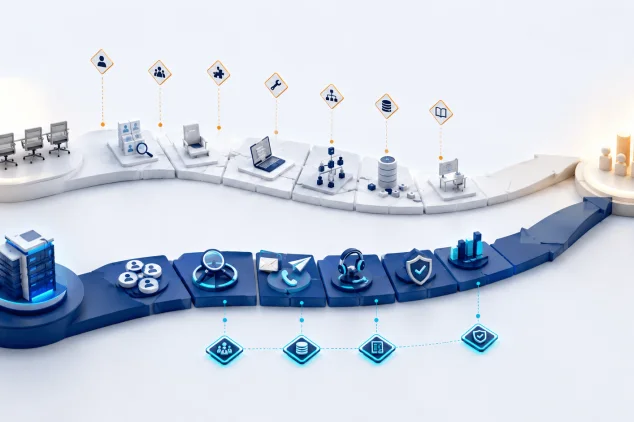
Outsourced SDR is usually the better economic choice when a company needs to test a market, lacks an experienced SDR manager, or wants capacity without building the operating system. An in-house team is usually the better long-term choice when sales development is a core capability, the product requires deep institutional knowledge, and the company can support several representatives under capable management.
Neither model wins in every case. The wrong comparison is one SDR salary versus one agency retainer. The useful comparison is total operating ownership: compensation, benefits, recruiting, management, data, tools, infrastructure, RevOps, QA, vacancy, ramp, and the client’s own time.
An outsourced provider can replace much of the recruiting, staffing, prospecting infrastructure, list production, frontline management, and campaign execution. It cannot replace the client’s product knowledge, account-executive feedback, commercial judgment, legal approvals, positioning decisions, or responsibility for converting meetings into pipeline.
| Decision Factor | In-House SDR | Outsourced SDR | What Changes the Answer |
|---|---|---|---|
| Cost structure | Payroll plus several shared and indirect costs | Retainer, setup, usage, or meeting-based fees | Team size, location, scope, and included systems |
| Ramp | Recruiting, onboarding, training, and process setup | Provider staffing and infrastructure already exist | Product complexity and provider readiness |
| Control | Direct control over people, message, and workflow | Control is defined through governance and contract | Access to reps, systems, recordings, and data |
| Management burden | Client hires, coaches, and retains the team | Provider handles frontline staffing and supervision | How managed the provider’s service really is |
| Tooling and data | Client selects, buys, connects, and administers | Often included, but not always | Licenses, data rights, domains, and CRM scope |
| QA | Client designs scorecards and coaching | Provider may supply QA and coaching | Recording access, sample size, and review cadence |
| Reporting | Built around the client’s CRM and definitions | Provider dashboard or client CRM | Field-level access and sales-acceptance feedback |
| Scalability | Headcount follows recruiting and manager capacity | Capacity can often change by contract or package | Provider bench, notice periods, and market coverage |
| Knowledge retention | Knowledge stays inside if employees remain | Knowledge can leave with the provider | Documentation, CRM discipline, and staff turnover |
| Exit flexibility | Employment obligations and stranded licenses | Contract terms and data migration | Initial term, cancellation, ownership, and export rights |
The practical rule is simple: outsource when you need a managed operating capability before you are ready to own it. Build in-house when the capability is stable, strategic, and large enough to support dedicated management. Use a hybrid model when internal account executives or SDRs need temporary capacity, specialist channels, or a controlled market test.
The Real Cost of an In-House SDR Team
The true monthly cost of an internal SDR function is the recurring cost of the people plus the system required to make their work usable. A rep without data, coaching, routing, QA, CRM administration, and account-executive feedback is headcount, not a complete sales-development function.
Current US compensation anchors
As of August 18, 2026, RepVue reports a US median SDR base salary of $60,000 and median on-target earnings of $85,000. RepVue is a sales-compensation dataset, not a government occupation category. Actual pay changes by city, segment, experience, quota, remote policy, and product difficulty.
The US Bureau of Labor Statistics reported that private-industry wages accounted for 69.9% of employer compensation costs in March 2026 and benefits accounted for 30.1%. At the aggregate level, that makes benefits about 43.1% of wages. Applying that broad workforce ratio directly to an SDR is an estimate, not an SDR-specific rule. Employer taxes, insurance, paid leave, retirement contributions, and commission treatment differ by company and state.
Management is material. The BLS reported a $138,060 median annual wage for sales managers in May 2024. A frontline SDR manager may earn more or less, and a manager’s capacity cannot be assigned to SDRs alone when that person also owns hiring, forecasting, enablement, operations, and account-executive coordination.
Illustrative annual cost for a 2-SDR US team
The model below is hypothetical. It uses current compensation anchors where available and labels company-specific operating inputs as assumptions. Replace every figure with your own payroll, vendor quotes, and staff allocations before making a budget decision.
| Cost Item | Assumption | Annual Cost | Notes |
|---|---|---|---|
| 2 SDRs at OTE | 2 x $85,000 | $170,000 | $60,000 base plus $25,000 variable per SDR |
| Benefits and payroll burden | 43.1% of base salaries | $51,720 | BLS aggregate benefits-to-wages ratio applied to $120,000 base |
| Recruiting and onboarding | $6,000 per hire | $12,000 | Illustrative year-1 allowance; replace with internal data |
| Manager allocation | 25% of $138,060 | $34,515 | Illustrative share of BLS sales-manager median wage |
| Data, sales tools, and infrastructure | $2,500 per month | $30,000 | Illustrative; vendor quotes and existing licenses matter |
| CRM, RevOps, and QA allocation | $1,500 per month | $18,000 | Illustrative internal labor allocation |
| Equipment | $2,000 per SDR | $4,000 | Illustrative year-1 hardware and setup |
| Vacancy and turnover reserve | 10% of base payroll | $12,000 | Planning reserve, not a predicted turnover rate |
| Total | Year-1 planning model | $332,235 | $27,686 per month |
This is not a claim that every 2-person SDR team costs $332,235. A remote team in a lower-cost labor market with existing licenses and a manager already in place may cost far less. A technical enterprise team in San Francisco or New York, with higher OTE, premium data, stronger enablement, and heavier management, may cost more.
Costs that budget sheets often miss
- Recruiting: job advertising, recruiter time, interviews, reference checks, offer work, and unfilled-seat time.
- Onboarding: payroll before a rep can independently research, call, write, qualify, and document.
- Management: one-to-ones, call review, pipeline inspection, coaching, capacity planning, hiring, and escalation.
- Data and tools: contact data, account research, dialer, email infrastructure, mailbox and domain administration, LinkedIn access, recording, and conversation review.
- CRM and RevOps: fields, routing, ownership, deduplication, dashboards, integrations, attribution, and list governance.
- QA: message review, call scorecards, compliance checks, coaching, and inspection of meeting quality.
- Turnover and vacancy: lost capacity, rehiring, a new ramp, account reassignment, and knowledge loss.
Monthly and annual cost formulas
Annual internal SDR cost = base pay + variable pay + benefits and payroll burden + recruiting + onboarding + manager allocation + data and tools + infrastructure + CRM and RevOps allocation + QA + equipment + vacancy and turnover reserve.
Monthly internal SDR cost = annual internal SDR cost divided by 12. For cash planning, also map when annual licenses, recruiting invoices, bonuses, and equipment purchases are actually paid.
Do not assign every system cost to each rep. Some licenses are per seat, while data platforms, CRM administration, and managers are shared. Cost per rep often falls as a well-run team grows, until another manager, data tier, or operations hire becomes necessary.
What You Actually Buy With Outsourced SDR
A managed outsourced SDR program should replace more than prospecting labor. The provider may supply recruiting, rep coverage, first-line supervision, research, data, outreach infrastructure, channel execution, QA, reporting, and documentation. The contract determines which of these are included.
What the provider may own
- Recruiting, employment, coverage, and replacement of assigned staff.
- Account and contact research against the approved target profile.
- Cold calling, email, LinkedIn, or a coordinated channel mix.
- Domains, mailboxes, dialer, data, and outreach tools when named in scope.
- Message drafting, sequence setup, reply handling, and meeting scheduling.
- Frontline coaching, call review, activity inspection, and staff supervision.
- Dashboard reporting, CRM updates, meeting notes, and campaign documentation.
These items are not automatic. A low retainer may buy shared sending capacity and lead forwarding rather than a dedicated, phone-capable SDR unit. Ask who performs each task, how much capacity is assigned, where the data lives, what can be exported, and what happens when a rep is absent.
What still belongs to the client
Outsourced does not remove the client’s need for product knowledge, account-executive feedback, and commercial decisions. The client must approve the target market, exclusions, offer, claims, qualification standard, pricing boundaries, legal rules, and definition of an accepted meeting.
Account executives must accept or reject meetings quickly using named reasons. Without that loop, the provider can see bookings but cannot distinguish wrong accounts, wrong roles, weak need, poor notes, no-shows, or sales follow-up failures.
The client also owns downstream conversion. An SDR provider can create conversations and qualified meetings. It does not control discovery skill, proposal quality, pricing, procurement, product fit, or closing.
What current public pricing shows
Public provider pricing is useful only when scope and term are read beside the number. The figures below were verified on official pages on August 18, 2026. They are examples, not a market-wide price range.
| Provider | Published Price | Published Structure | Comparison Caution |
|---|---|---|---|
| LevelUp Leads | Starts at $5,000 | Fractional and full-service options; initial 3 months, then month to month | Starting price is not the price of every package or scope |
| EBQ | $5,000 monthly half-time; $10,000 monthly full-time | US-based employee model with annual commitment | Staffing structure differs from a campaign package |
| SalesRoads | $9,950 per 4 weeks | Full SDR program with dedicated SDR and management support | 13 four-week billing periods equal $129,350 per year |
| CIENCE | Modular fees | $5,000 setup, $2,000 monthly strategic team, $499 platform, SDR capacity and other fees | Total depends on geography, SDR level, onboarding, and held meetings |
A $60,000 annual starting retainer and a $129,350 annual full SDR program are not directly interchangeable. One may assign fractional capacity while another may include a dedicated representative, management, data, and QA. Normalize every proposal by assigned capacity, channels, data, systems, management, reporting, term, and meeting definition.
ROI, Risk, Ramp, and Scalability Compared
ROI depends less on the employment model than on productive capacity, accepted-meeting quality, downstream conversion, and gross profit. Cost matters, but a cheaper team that reaches the wrong accounts or produces rejected meetings can have worse economics.
A practical ROI model
Expected gross profit per accepted meeting = accepted-meeting-to-customer rate x average gross profit per new customer.
Break-even accepted meetings = annual SDR cost divided by expected gross profit per accepted meeting.
Example: if annual SDR cost is $120,000, 10% of accepted meetings become customers, and average gross profit per new customer is $20,000, expected gross profit per accepted meeting is $2,000. The model needs 60 accepted meetings to cover the annual SDR cost. This is arithmetic, not a forecast.
Use gross profit rather than contract revenue when delivery has material cost. Use cohort data rather than mixing new and mature campaigns. If the sales cycle is longer than the measurement window, calculate pipeline creation separately and delay the closed-won calculation until enough opportunities mature.
Ramp and time-to-pipeline risk
An internal build starts with role design, budget approval, recruiting, hiring, onboarding, training, data access, tool setup, messaging, and supervision. An experienced organization may complete those steps quickly. A first-time SDR employer may discover dependencies only after the hire begins.
An established provider can begin faster because staffing and infrastructure already exist. Published launch timing is not the same as productive pipeline. LevelUp Leads states a 7- to 10-day campaign launch, for example, but buyer response, meeting timing, and pipeline creation still depend on the market, proposition, account list, and sales cycle.
Control and operating risk
In-house teams give the company direct employment control and faster access to internal experts. They also concentrate recruiting, management, compliance, tooling, and continuity risk inside the company.
Outsourcing transfers some staffing and operating risk to the provider but adds vendor risk. Poor documentation, inaccessible data, weak contract terms, staff sharing, or a proprietary reporting layer can make the client dependent on a vendor it cannot inspect.
Control should be tested through access: Can the client review messages and recordings? Can it see account-level activity? Can it change exclusion rules? Does it own domains, mailboxes, and data? Can it export history? Does the provider document the playbook before exit?
The assumptions that change the conclusion most
- Accepted-meeting rate: count held meetings accepted by sales, not bookings.
- Win rate: a small change can materially alter required meeting volume.
- Gross profit per customer: high-delivery-cost contracts cannot be judged on revenue alone.
- Time to productive capacity: include recruiting, onboarding, campaign preparation, and sales-cycle delay.
- Manager allocation: a 1-person team can be expensive if it requires a new manager or heavy founder time.
- Tool and data reuse: existing licenses lower internal incremental cost; duplicated vendor stacks raise it.
- Vacancy and continuity: model the cost of an empty seat and another ramp without assuming a universal turnover rate.
- Provider scope: fractional prospecting, a dedicated SDR, and a managed team are different products.
Run at least 3 cases: conservative, base, and strong. Change accepted-meeting rate, win rate, gross profit, and ramp first. A decision that works only under the strongest case is not yet supported.
Decision Framework: Which Model Fits Your Company?
Choose based on the capability you need now, the capability you want to own later, and the evidence available today. Company stage alone is not enough.
Scenario 1: Early-stage market test
Default choice: outsourced or founder-led plus fractional support.
A company testing a new segment usually needs message learning, account feedback, and controlled cost before permanent hiring. An outsourced team can supply research and channel execution while founders or senior sellers join early calls.
The exception is a product so new or technical that only the founder can explain it. In that case, keep discovery internal and outsource research, list work, or selected outreach tasks until the message is repeatable.
Scenario 2: Mature enterprise team needing capacity
Default choice: hybrid.
A mature team may already own targeting, CRM, enablement, account planning, and account-executive feedback. An outside team can add a region, segment, event follow-up motion, or temporary calling capacity without changing the internal operating core.
The exception is a regulated or deeply technical sale where outside access, claims, or data handling create unacceptable risk. Internal hiring may be slower but give better governance and knowledge retention.
Scenario 3: Company with no SDR manager
Default choice: managed outsourced team.
Hiring one junior SDR without a manager often moves the management job to a founder, account executive, or marketing leader. The payroll line looks lower, but campaign design, coaching, QA, tools, and reporting still need owners.
The exception is a senior founding SDR or player-coach who can build the function. That hire costs more than an entry-level rep but may be the right first internal investment.
Scenario 4: Technical product with a long sales cycle
Default choice: in-house or tightly governed hybrid.
Technical products need accurate claims, careful qualification, multi-contact account work, and detailed handoffs. Internal teams retain product knowledge and can work closely with product specialists. A specialist provider can still work when it has named training, call review, approved claims, and rapid sales feedback.
Do not require the provider to force budget and timing questions too early. For long cycles, relevant need, account fit, role, current approach, change trigger, and agreed next step may be better first-meeting criteria.
Scenario 5: Stable repeatable motion at larger scale
Default choice: build the internal core and use outside capacity selectively.
Once a company has repeatable segments, proven messages, enough headcount for a manager, reliable sales feedback, and a reason to retain knowledge, internal ownership becomes easier to justify. Shared manager, data, and RevOps costs can be spread across more representatives.
Outsourcing can remain useful for new territories, seasonal programs, database work, specialized calling, or capacity during hiring gaps.
Questions to answer before choosing
- Do we have a defined target market and an offer buyers can understand?
- Who will manage SDR work every week?
- How much productive capacity do we need, and for how long?
- Which product knowledge and claims cannot leave the company?
- What counts as a held, qualified, and sales-accepted meeting?
- Can account executives return structured feedback within 2 business days?
- What is the fully loaded annual cost under conservative, base, and strong cases?
- Who owns the CRM records, domains, mailboxes, lists, recordings, and playbook?
- What happens if the first segment or message fails?
- What does exit cost, and how quickly can capacity change?
The final decision is not outsourcing versus people. Both models rely on people. It is a choice about where employment, management, systems, learning, and risk should sit. Put every cost and responsibility in one model, test the assumptions that drive the answer, and select the structure your company can govern well.
FAQ
Outsourcing is often cheaper for a small team because the retainer may include recruiting, frontline management, data, tools, infrastructure, QA, and staff coverage. It is not always cheaper at larger scale. Internal cost per rep can fall when several SDRs share a manager, systems, and operations support. Compare the provider's full scope with base pay, variable pay, benefits, recruiting, management, tools, RevOps, equipment, vacancy, and ramp.