
Company
Learn
Home / About Us / Podcasts / How to Stand Out as an SDR – Ep. 10

How to Stand Out as an SDR – Ep. 10

About Episode:

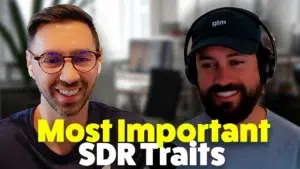
In this episode of Prospecting Pros, hosts John and Chris chat with Arely Brattin, Sales Development Manager at Orum. Arely shares her journey from inbound rep at ZoomInfo to leading Orum’s entire sales development program, managing six reps across commercial, enterprise, and strategic accounts.

She also reveals three things that make certain SDR candidates stand out from others during hiring. Arely shares how 90% of Orum’s meetings come from phone calls, with LinkedIn as a strong secondary channel, while emails prove less effective.

She talks about the importance of robust onboarding programs, explaining that even talented hires will fail without the right setup and training. Arely also shares her thoughts on connection rates,data quality, and why former athletes and teachers tend to crush it in sales roles.


Ready to improve your sales funnel?

Ready to improve
your sales funnel?

We help you source new contacts, create strategies, run campaigns and create new sales opportunities.

Recent Episodes:

How Top SDR Teams Are Evolving with AI – Ep. 33
Elric Legloire ran SDR teams at Chili Piper, earning three or four promotions in two years, before leaving to advise companies on his own. Working solo, he says, is what lets him see the same handful of problems repeat across every industry. His take on promotion: it doesn't come from being the top performer, it comes from visibly improving the playbook and coaching the people around you. When he hires, he runs a role-play and watches how the candidate takes feedback, because someone who pushes back on coaching early rarely takes it later. On AI, he thinks the panic about SDRs disappearing has it backwards. Thirty thousand more SDRs were added globally over the past year, and OpenAI and Anthropic are now hiring reps to go after their biggest accounts. What has actually changed is the day itself: prospecting used to eat about a third of the week and now runs closer to 80%. He also tells clients to expect a full year before outbound turns into revenue, once you account for the sales cycle, hiring, and ramp. The episode wraps up with practical advice on asking better discovery questions, building SDR programs from scratch, and how sales professionals can stand out by focusing on genuine curiosity, empathy, and solving real customer problems.
Why Hard Work Beats Talent in Sales – Ep. 32
Matt Bastin liked sales but couldn't stand selling insurance in Ireland, so he moved to Canada for a tech job and made a game of catching the office's top performer. He outworked people rather than out-talenting them. He now runs an inbound team of about 30 at Clio, and when he hires he looks for the opposite of a polished candidate. He wants to see the cracks. He asks everyone the same two things in an interview: one thing you love about sales and one thing you hate. He also keeps the room relaxed on purpose, because nobody's dying if you fumble a phone call. He likes AI for role-play and onboarding, and his new hires run close to 100 practice conversations before they ever dial a real number. But he draws a line at leaning on it too hard. It's a tool, not a replacement for knowing how to write the email yourself. His biggest regret is not taking the career seriously until 28, and once taking a high-paying fintech job to sell something he couldn't stand talking about. The episode wraps up with practical advice on asking better discovery questions, building SDR programs from scratch, and how sales professionals can stand out by focusing on genuine curiosity, empathy, and solving real customer problems.
The #1 Trait Every Great SDR Has – Ep. 31
Matt Roberts got into tech sales almost by accident. He was pouring wine in Santa Barbara when friends pulled him into an SDR seat, and he rode that start all the way to director of sales development at Chili Piper. These days he places reps at AI-native startups. Ask him what he screens for and the answer is coachability and curiosity, ahead of experience every time. In his view no good SDR is missing either one, with grit and a real team-first streak close behind. He's blunt that booking a meeting is harder now than it was in 2019, and that your online presence often decides whether a prospect even bothers to reply. The two things most early-career reps skip, building a network on purpose and making yourself hard to replace, are the ones that pay off for years. The episode wraps up with practical advice on asking better discovery questions, building SDR programs from scratch, and how sales professionals can stand out by focusing on genuine curiosity, empathy, and solving real customer problems.
Startup Failures & Scaling to $16 million ARR – Ep. 30
Nick Velkovski failed something like ten startups before HeyReach. The one right before it, a Reddit marketing tool, burned through the largest raise in Macedonia's history in a single year. HeyReach itself sat stuck under $8K MRR until a co-founder talked him into niching all the way down to lead-gen agencies. From there he bet on integrations instead of trying to build an all-in-one product, and that bet carried the company to $16M ARR. Asked what he'd do differently, he doesn't hedge: hire seniors sooner, start trusting the data earlier, get on AI faster. His bigger point is that luck isn't only something that happens to you. You can manufacture it by putting yourself in enough situations where it has a chance to find you.They talk about the common mistakes SDRs make and Dillon says that bad follow up is often the biggest reason opportunities are lost. He explains how prioritizing prospects, eliminating friction and making scheduling easy dramatically improves conversion rates. Dillon also talks about the importance of multi-channel prospecting via phone, email, and LinkedIn, while adjusting to evolving buyer behaviors. The episode wraps up with practical advice on asking better discovery questions, building SDR programs from scratch, and how sales professionals can stand out by focusing on genuine curiosity, empathy, and solving real customer problems.
Why Follow-Ups Lead To Sales – Ep. 29
In this episode of Prospecting Pros, John Karsant talks to Dillon Tucker about his transition from finance and insurance sales to SaaS, SDR leadership, and fractional growth consulting. Dillon shares his early mentorship experiences at Outreach that sparked his love for coaching and developing sales talent. They talk about the common mistakes SDRs make and Dillon says that bad follow up is often the biggest reason opportunities are lost. He explains how prioritizing prospects, eliminating friction and making scheduling easy dramatically improves conversion rates. Dillon also talks about the importance of multi-channel prospecting via phone, email, and LinkedIn, while adjusting to evolving buyer behaviors. The episode wraps up with practical advice on asking better discovery questions, building SDR programs from scratch, and how sales professionals can stand out by focusing on genuine curiosity, empathy, and solving real customer problems.
Like what you hear?
Let’s keep leveling up

New episodes weekly with real outbound strategies you can apply today.

Subscribe to our YouTube channel for expert interviews, no-fluff tactics, and behind-the-scenes insights from the world of B2B sales.