

What Is Multichannel Outbound, and Why Single-Channel Outreach Falls Short
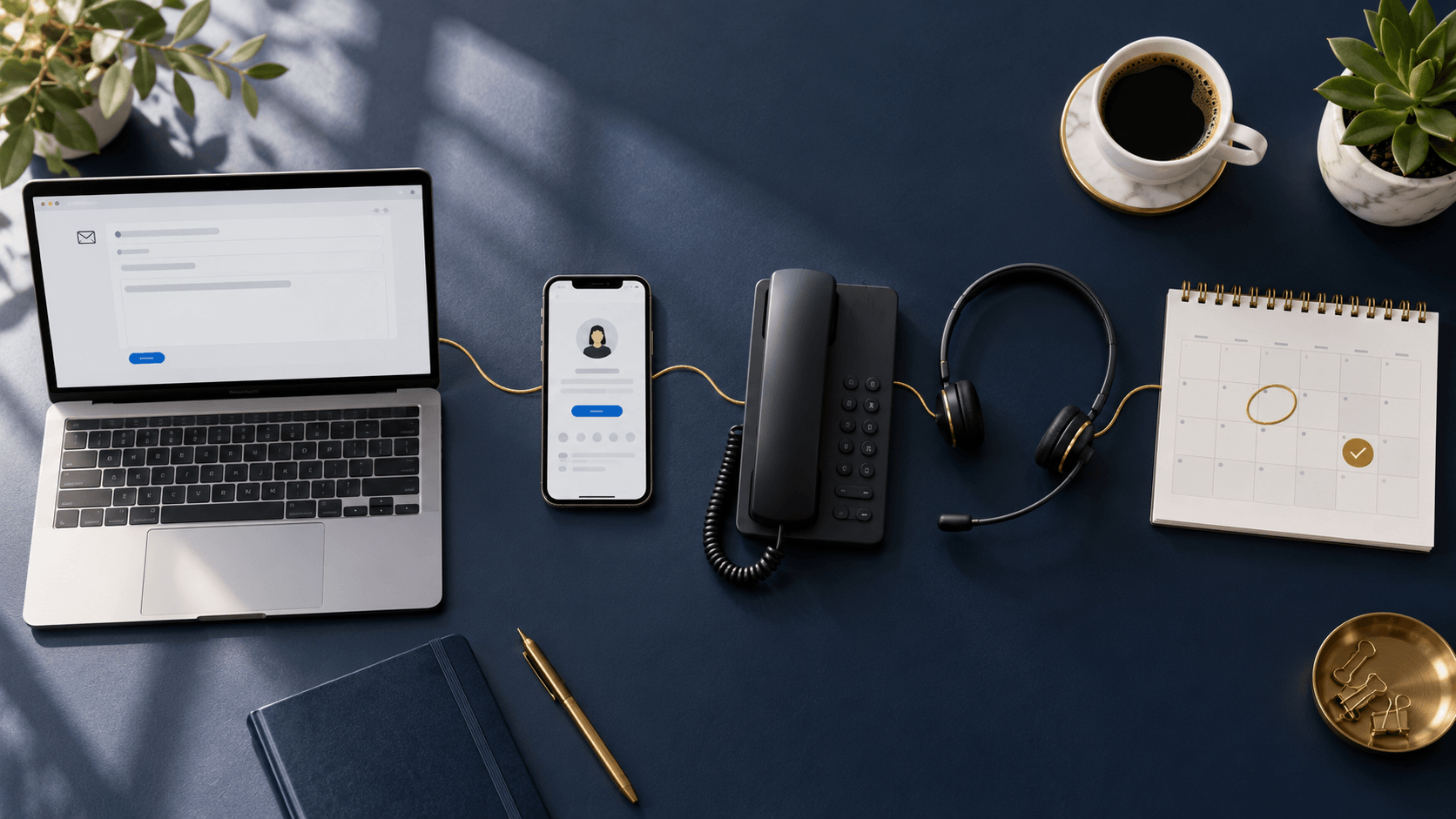
Multichannel outbound is the practice of coordinating email, LinkedIn, and cold calling into one timed sequence, where each touch builds on the last. It is not three separate campaigns running in parallel.
An SDR (Sales Development Representative) who works this way treats an account as a single target and moves it through a planned cadence, the ordered set of touches spaced over days. The goal is qualified pipeline, meaning the sum of sales opportunities your outbound creates, and specifically sales-accepted pipeline that your account executives agree is worth pursuing.
A weak approach blasts each channel independently. The email list, the LinkedIn list, and the call list never talk to each other, so a prospect gets three cold, disconnected messages. A strong approach sequences the channels so the third touch feels like a continuation of the first.
The three-stage logic is simple. Per Outbound Sales Pro, email warms the account and builds name recognition, LinkedIn builds credibility and triggers familiarity, and the cold call converts a warm account into a booked meeting. Email warms, LinkedIn validates, and the call closes for the meeting.
Multichannel and omnichannel describe the same idea: reaching one buyer across two or more coordinated channels. As part of LevelUp Leads’ go-to-market approach, we design full-funnel, multi-touch outbound cadences that combine email, LinkedIn, and cold calling as core channels. For a deeper look at how each channel works on its own, read our guide to multi-channel outbound lead generation.
How to Build a Multichannel Outbound Sequence
Sequencing is where most outbound programs break. The channel order stays constant. The timing and handoff rules are what you tune. Below is a five-step build for email, LinkedIn, and cold calling as a single motion.
Step 1: Define your ICP and channel priority by segment
Your ICP (Ideal Customer Profile) defines the accounts worth pursuing: company size, industry, tech stack, and buying triggers. Not every prospect deserves the full three-channel treatment. Per Dievio, reserve multichannel treatment for accounts where deal value, account fit, or a strong buying signal justifies the extra touches. Use a lighter mix for the rest.
- High-priority segments: email, LinkedIn, and cold call, all three channels.
- Mid-priority segments: email plus LinkedIn.
- Low-priority segments: email only.
This protects SDR time and keeps meeting quality high. Effective B2B prospect list building services start here, tiering accounts by fit before a single touch goes out.
Step 2: Sequence email, LinkedIn, and cold calling in the right order
The core sequencing logic from Dievio is email first to establish relevance, LinkedIn second to build familiarity, then the call once the name is no longer cold.
Exact timing varies by program, but the email-to-LinkedIn-to-call order stays constant. 2 published models show the range:
| Touch | ConnectSafely Model | PuzzleInbox Model |
|---|---|---|
| 1 | Email, Day 1 | Email, Day 1 |
| 2 | LinkedIn connection, Day 3 | LinkedIn connection, Day 2 |
| 3 | LinkedIn message, Day 5 | Follow-up email, Day 5 |
| 4 | Phone call, Day 8 | LinkedIn message, Day 7 |
| 5 | Follow-up email, Day 10 | Cold call, Day 10 |
Both start with email and put the call after LinkedIn has done its work. The days differ; the logic does not.
Step 3: Set cadence and spacing between touches
Spacing controls whether repetition feels helpful or spammy. The published sequences above spread 4 to 5 touches across roughly 10 days to 2 weeks. That gives the prospect time to read an email and accept a connection before the phone rings.
2 guidelines hold across programs:
- Leave at least 2 days between touches on different channels so each one registers before the next.
- Do not stack 2 touches on the same day; it reads as pressure, not persistence.
In phone-responsive industries, you can compress the front of the sequence and get to the call sooner. The program results below show that tradeoff in practice.
Step 4: Vary messaging by channel so touches reinforce each other
Multichannel does not mean sending the same message everywhere. Each channel carries a different job. Per Dievio, the email should deliver a concise problem, a proof point, and a single CTA. LinkedIn validates the sender. The phone clarifies and advances the conversation.
Devlo puts it in shorthand: email educates, LinkedIn creates the relationship, calling qualifies. The same source gives the coordination rule that makes the whole system work: a prospect who responds on one channel should be removed from the others.
Problem-led messaging on every touch means the call opens where the email left off, not from zero.
Step 5: Build handoff rules so channels don’t collide
Handoff rules stop your channels from stepping on each other. The first rule is the response rule from Step 4: a reply on any channel pulls the prospect out of the rest.
The second rule is reference discipline. Per ConnectSafely, reference prior touchpoints in each subsequent channel. Mention the email when you send the LinkedIn note. Mention both the email and the connection when you call. Repetition then reads as continuity instead of spam.
LevelUp Leads’ own CoreVest program ran cold calling as the primary channel, supported by email and LinkedIn to build familiarity and improve conversion. The Zontec program followed the same pattern: 75 of 81 booked meetings came from cold calling, with email and LinkedIn layered on for coverage. Phone-first sequencing can outperform email-first sequencing in phone-responsive industries.
What Each Channel Contributes, and the Results to Expect
Each channel earns its place by building the case for the next one. Email creates context, LinkedIn creates familiarity, and the call turns that familiarity into a booked meeting.
Email: building context before the first conversation
Email is the least intrusive touch and often the underrated one. Used well, it warms the account before anyone picks up the phone. From our multi-channel outbound guide:
- Optimize every email for mobile; most prospects read on a phone.
- Prioritize a smaller, targeted list over mass sends to avoid spam flags.
- Personalize each message rather than sending a bland template.
A tight, relevant email is the reason the LinkedIn note and the call land later. Our cold email services run on this principle: targeted lists and personalized copy, not volume for its own sake.
LinkedIn: establishing credibility and familiarity
LinkedIn is where the prospect checks who is contacting them. It builds the familiarity that makes a cold call feel less cold. From the same guide:
- Tailor the business profile to reflect authority in your space.
- Stay visible through relevant posts and group activity.
- Interact with leads through likes and comments before pitching to build the relationship.
Add two tactical moves from ConnectSafely: personalize the connection request by referencing your earlier email, and once connected, send a value-first message, such as a case study or article, before asking for a meeting.
Cold calling: converting warm interest into booked meetings
Cold calling is where warm interest becomes a booked meeting. By the time the phone rings, the prospect has seen your email and your LinkedIn profile. From the same guide:
- Open with a strong hook instead of a banal opener.
- Ask questions about the prospect’s problems.
- Personalize the conversation rather than reading a rigid script.
The CoreVest program shows what a trained caller produces off a warmed account. Per the CoreVest case study, cold calling converted 28.37% of conversations into meetings (223 of 786 conversations) and achieved a 28.97% connect-to-conversation rate from 2,713 connects. The Zontec program reinforces the point: even in a manufacturing segment, the phone-led motion held once email and LinkedIn had warmed the accounts.
Program results: meetings, pipeline, and ramp time
A cold-calling-led outbound program for CoreVest, supported by email and LinkedIn across two segmented campaigns, booked meetings with net-new accounts. Per the CoreVest case study:
- 224 meetings booked in two months (223 from cold calls, 1 from email and LinkedIn).
- $10M+ in sales pipeline generated within two months.
- 28.37% conversation-to-meeting conversion rate.
- 679 LinkedIn connection requests (74 new connections).
- 10,461 emails sent across two segmented campaigns.
An outbound program for Ammann targeting net-new heavy equipment buyers ran phone-first with email and LinkedIn support. Per the Ammann case study:
- $30M in qualified pipeline generated.
- $30M in closed heavy equipment business within one month.
- 5,530 dials in the first month.
- 401 connects (7.25% dial-to-connect rate).
- 209 conversations (52.12% connect-to-conversation rate).
- 11 qualified meetings with net-new buyers.
A dedicated, cold-calling-led program for Zontec in manufacturing quality software ran the phone as the primary channel with email and LinkedIn layered on:
- 81 qualified meetings booked in under six months.
- 75 meetings from cold calling.
- 6 meetings from email and LinkedIn combined.
- 4x+ increase over the client’s previous monthly meeting average.
On ramp time, per the Zontec case study, campaigns typically launch 7 to 10 business days after onboarding, with meetings starting within the first weeks.
The pattern is consistent. Cold calling did the heavy lifting in both the CoreVest and Zontec programs, while email and LinkedIn built the familiarity that made the calls land. That is the operational meaning of integration. These figures describe individual campaign results, not forecasts for another company.
Comparing Multichannel Outbound Approaches: Which Agency or Channel Mix Fits
The right channel mix depends on your ICP and how your buyers respond. LinkedIn-led agencies suit relationship-driven segments. Full-service multichannel agencies suit teams that want email, LinkedIn, and cold calling run as one system. The table below compares seven approaches; competitor figures are attributed to their published sources in the sections that follow.
| Company | Primary Channel Focus | Reported Pricing | Best For | Customer Rating |
|---|---|---|---|---|
| LevelUp Leads | Email, LinkedIn, cold calling (integrated) | From $5,000/month | B2B teams wanting a full multichannel motion run for them | 11:1 reported ROI |
| Belkins | Enterprise omnichannel | $5,000–$15,000/month band | Enterprise omnichannel programs | Highly rated |
| CIENCE Technologies | Enterprise omnichannel | ~$4,200–$9,000/month plus setup fee | Enterprise omnichannel programs | Highly rated |
| Martal Group | Global multichannel reach | Custom | Companies needing global reach | Highly rated |
| Callbox | Multichannel appointment setting | Custom | Multichannel appointment setting at scale | Highly rated |
| Cleverly | LinkedIn-led | Custom | LinkedIn-first lead generation | Highly rated |
| SalesRoads | Phone-first | Custom | Cold-calling-led appointment setting | Highly rated |
Best LinkedIn lead generation agencies
Among the best LinkedIn lead generation agencies, Cleverly leads with LinkedIn as its primary channel, per OutreachBloom. LinkedIn-first programs work well when your buyers are active on the platform and respond to relationship-building before a direct ask.
The tradeoff is coverage. A LinkedIn-only motion skips the surrounding email and phone touches. For phone-responsive industries like manufacturing, a LinkedIn-only program leaves meetings on the table, as our Zontec numbers show.
Multichannel outbound sales agencies for full integration
Full-service multichannel outbound sales agencies run all three channels as one system. Per OutreachBloom, Belkins and CIENCE offer enterprise omnichannel, SalesRoads is phone-first, and Martal Group provides global reach.
On pricing, OutreachBloom reports that email-only agencies typically charge $1,000 to $5,000 per month, while full-service omnichannel agencies with dedicated SDRs usually run $5,000 to $15,000 per month. It places Belkins in that band, notes CIENCE runs roughly $4,200 to $9,000 per month plus a setup fee, and reports pay-per-meeting pricing commonly falls between $150 and $600 for mainstream B2B ICPs.
Additional reviews of the best B2B cold email agencies and best B2B cold calling companies appear in guides from Saleshandy and Salesforge, which evaluate providers on list quality, deliverability, and booked meetings rather than send volume.
A weak agency sells activity. A strong partner protects pipeline quality. LevelUp Leads runs email, LinkedIn, and cold calling as one integrated motion, with 5,100+ annual meetings booked and an 11:1 ROI across 1,000+ clients served. Pricing starts at $5,000 per month across Fractional SDR, Full-Service SDR, and Growth packages, and our SDRs integrate with Salesforce, HubSpot, and Zoho for source attribution and clean reporting.
See how we compare in our roundups of the best B2B lead generation agencies for 2026 and the top B2B appointment-setting companies. When you’re ready, schedule a call to map your channel mix to your ICP and build a multichannel motion that fills your pipeline.
FAQ
Start with email to establish relevance, add LinkedIn to build familiarity, then call once the name is no longer cold. This order holds across published models, even when the exact days differ. Phone-responsive industries are the exception, where you can compress the early touches (see Step 3).