


Key Takeaways
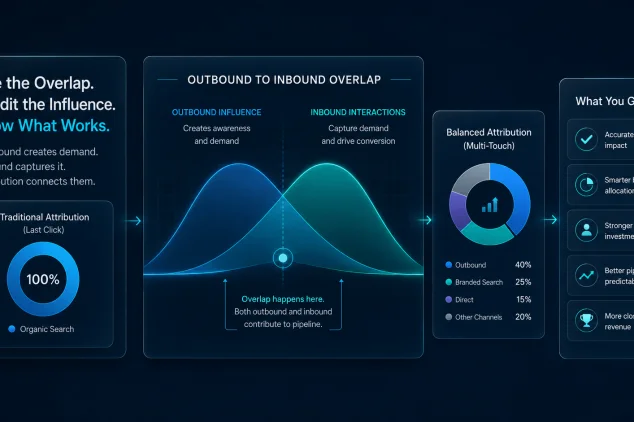
In modern B2B buying journeys, outbound often creates inbound behavior later. A prospect receives a cold email, ignores it, searches the brand three days later, reads a comparison page, returns through direct traffic, asks a peer about the company, and then books a demo two weeks later.
In most attribution systems, that journey gets credited to organic search, direct traffic, or the demo page.
Outbound disappears.
That is the outbound to inbound overlap problem.
The practical answer is not to pretend attribution can see everything. It cannot. The practical answer is to build a measurement system that combines first-party tracking, CRM campaign history, branded search analysis, self-reported attribution, account-level timelines, and pipeline reporting.
B2B attribution should not ask, “Which channel gets all the credit?” It should ask, “Which touchpoints created demand, which captured demand, and which helped move the account into pipeline?”
What is B2B marketing attribution?
B2B marketing attribution is the method of assigning credit to the marketing and sales activities that influence a lead, opportunity, or customer.
It can include:
- Organic search
- Paid search
- Paid social
- Cold outbound
- SDR calls
- LinkedIn outreach
- Website visits
- Email marketing
- Webinars
- Events
- Review sites
- Referrals
- Direct traffic
- Branded search
- Sales conversations
- Retargeting
- Partner influence
B2B attribution is harder than B2C attribution because sales cycles are longer, buying committees are larger, and many touchpoints happen before a buyer fills out a form. Multi-touch attribution is often used because it distributes credit across multiple interactions instead of giving all credit to the first or last click. (Improvado)
Why outbound to inbound overlap matters
Outbound to inbound overlap happens when outbound activity creates awareness or intent, but the buyer later converts through an inbound path.
Example:
- SDR sends a cold email to a VP Sales.
- The VP Sales does not reply.
- Two days later, the VP searches the company name on Google.
- They read the homepage and a case study.
- A RevOps teammate later visits the pricing page.
- The account returns through direct traffic.
- Someone books a demo.
- CRM credits the lead to organic search or direct.
The attribution report says inbound created the opportunity.
The actual journey says outbound likely introduced or accelerated the account.
This matters because if outbound influence is invisible, leadership may underfund SDR, overcredit branded organic, and misunderstand how demand is created.
The dark funnel problem
The dark funnel refers to buyer activity that influences a purchase but is not fully visible in analytics or CRM. This can include private Slack conversations, LinkedIn DMs, peer recommendations, podcast mentions, review research, word of mouth, and anonymous website visits. (INFUSE)
For B2B teams, the dark funnel is not an excuse to avoid measurement. It is a reminder that attribution reports are partial evidence.
Dark funnel influence often appears indirectly through proxy signals:
- Branded search growth
- Direct traffic lift
- Returning visitors
- Website visitor signals
- Self-reported attribution
- Sales call mentions
- Account-level engagement
- Increased demo conversion from target accounts
- More “heard about you from…” responses
- Shorter sales cycles for warmed accounts
Recent dark funnel measurement guidance specifically points to branded search volume, direct traffic spikes, and self-reported attribution as useful proxy signals for activity that software attribution cannot fully capture. (CyberEdge Group)
Why standard attribution models miss outbound influence
Most attribution models are built around visible digital touchpoints.
That creates several problems.
1. Outbound touches may not create clicks
A cold email can create awareness without a click.
The buyer may:
- Google the brand
- Ask a peer
- Visit the website from another device
- Forward the email internally
- Come back later through direct traffic
If the buyer never clicks the outbound email, standard tracking misses the influence.
2. Branded search captures demand created elsewhere
Branded search often looks like the source of conversion.
But branded search is frequently a demand capture channel.
The buyer searched the brand because something else created awareness.
That “something else” may have been:
- Cold outbound
- LinkedIn content
- Word of mouth
- Podcast mention
- Peer recommendation
- Event exposure
- Retargeting
- Analyst or review site research
If you credit branded organic with all the value, you may overvalue the capture point and undervalue the demand creation point.
3. Direct traffic hides source history
Direct traffic often includes buyers whose source is unknown, stripped, delayed, or cross-device.
A buyer may first see outbound on a work laptop, later visit the site directly from a phone, and then convert from a different browser.
The report may say “direct.”
The buyer journey says “unknown path with prior influence.”
4. Buying committees break person-level attribution
B2B opportunities are account-level decisions.
One person may receive outbound. Another may search the brand. Another may book the demo. Another may approve the budget.
If attribution only tracks the form submitter, it misses the buying committee.
5. CRM campaign tracking is often incomplete
Many teams fail to log:
- Outbound campaign membership
- SDR touches
- Call outcomes
- Email replies
- LinkedIn touches
- Account-level campaign exposure
- Sales-sourced influence
- Recycled leads
- Re-engaged accounts
If CRM activity is incomplete, attribution becomes guesswork.
B2B attribution models explained
First-touch attribution
First-touch attribution gives all credit to the first recorded interaction.
Best for:
- Understanding demand creation
- Identifying first known source
- Seeing which channels introduce new accounts
Weakness:
It ignores later influence.
If outbound touches a prospect first but the buyer later converts through branded search, first-touch can help preserve the outbound source if the outbound touch was recorded correctly.
Last-touch attribution
Last-touch attribution gives all credit to the final recorded interaction before conversion.
Best for:
- Understanding conversion paths
- Evaluating capture channels
- Measuring form or demo page performance
Weakness:
It overcredits the final step.
Last-touch often overcredits direct, organic brand, paid brand, and demo pages.
Linear multi-touch attribution
Linear attribution gives equal credit to every recorded touchpoint.
Best for:
- Simple multi-touch visibility
- Showing that multiple channels contributed
Weakness:
It treats all touches as equally important.
A pricing page visit and a low-intent blog visit should not always receive the same weight.
Time-decay attribution
Time-decay attribution gives more credit to touchpoints closer to conversion.
Best for:
- Longer sales cycles
- Understanding late-stage acceleration
Weakness:
It may undervalue early demand creation.
If outbound created awareness weeks before the demo, time-decay may undercredit it.
U-shaped attribution
U-shaped attribution gives more credit to the first touch and lead conversion touch.
Best for:
- Measuring source creation and lead capture
- Demand generation teams tracking lead creation
Weakness:
It may miss sales development and opportunity-stage influence.
W-shaped attribution
W-shaped attribution gives major credit to first touch, lead creation, and opportunity creation.
Best for:
- B2B teams focused on pipeline
- Understanding which channels create opportunities
Weakness:
It still depends on clean tracking and may miss dark funnel influence.
Account-based attribution
Account-based attribution evaluates touches across all contacts within an account.
Best for:
- ABM
- Enterprise sales
- Buying committee analysis
- Outbound to inbound overlap
Weakness:
It requires clean CRM account matching and strong data governance.
For outbound to inbound overlap, account-based attribution is usually more useful than person-only attribution.
The best model for tracking outbound to inbound overlap
There is no perfect model.
The best approach is a blended attribution framework.
Use:
- First-touch attribution to preserve original account creation source.
- Multi-touch attribution to capture visible touchpoints.
- Account-based attribution to connect multiple stakeholders.
- Self-reported attribution to capture what software misses.
- Dark funnel proxies to measure branded search, direct traffic, and account-level lift.
- CRM campaign influence to connect outbound touches to later inbound conversion.
Multi-touch attribution reframes measurement from channel-level reporting to journey-level contribution, which is essential in long B2B buying cycles. (Improvado)
The outbound to inbound attribution framework
Step 1: Record outbound touches in CRM
Every meaningful outbound touch should be logged.
Track:
- SDR campaign
- Sequence name
- Email sent
- Email opened, if reliable
- Clicks
- Replies
- Calls
- Connects
- Voicemails
- LinkedIn touches
- Meeting booked
- Meeting held
- Disqualification reason
- Account status
- Contact status
Do not rely only on email clicks. Outbound influence often happens without clicks.
Step 2: Create account-level campaign membership
Add target accounts and contacts to CRM campaigns.
Example campaign names:
- Outbound_Q2_Enterprise_SaaS_VP_Sales
- Outbound_RevOps_HubSpot_ICP_Tier1
- Outbound_ABM_Target_Accounts_2026
- Outbound_Cold_Call_Reactivation_Q3
This lets RevOps later ask:
“Did this inbound demo come from an account that was previously touched by outbound?”
Step 3: Capture first known touch and first meaningful touch
These are not always the same.
First known touch:
- The first recorded interaction in your system.
First meaningful touch:
- The first interaction that likely created real awareness or intent.
Example:
A list upload may create a CRM record, but the first meaningful touch may be an SDR email, a cold call conversation, or a pricing page visit.
Track both where possible.
Step 4: Measure branded search lift
Outbound can increase branded search when prospects search your company after exposure.
Track:
- Branded search impressions
- Branded search clicks
- Branded organic traffic
- Branded paid traffic
- Search Console branded query growth
- Branded search by geography, if relevant
- Branded search during outbound campaign windows
Look for patterns:
- Did branded search increase after a campaign launch?
- Did branded search rise in target regions?
- Did branded search lift among target account segments?
- Did demo requests from branded organic increase after outbound volume increased?
This does not prove causation by itself. It is a useful proxy.
Step 5: Track direct and returning traffic from target accounts
Direct traffic can hide prior influence.
Track:
- Direct traffic from target accounts
- Returning visitors from target accounts
- Visit frequency after outbound touches
- Pages viewed after outbound
- Multiple stakeholders from same company
- Demo or pricing visits after outbound touches
Website visitor identification tools can help identify company-level visits, but accuracy varies by vendor and should be validated before routing signals into sales workflows.
Step 6: Use self-reported attribution
Add a form field:
“How did you hear about us?”
Keep it optional or low-friction.
Examples:
- Google search
- Podcast
- Peer recommendation
- Cold email
- Sales rep
- Webinar
- Event
- Review site
- Not sure
- Other
Self-reported attribution is not perfect. Buyers forget. Buyers simplify. Buyers may mention the most memorable touch, not the first touch.
But it captures influence that tracking cannot.
Step 7: Connect SDR activity to opportunity creation
For every opportunity, RevOps should be able to answer:
- Was this account previously touched by outbound?
- Which contacts were touched?
- Which contacts engaged?
- Did inbound conversion happen after outbound?
- How many days passed between outbound and inbound?
- Which pages did the account visit?
- Did the opportunity include previously prospected contacts?
- Did sales mention outbound influence in notes?
This is where outbound to inbound overlap becomes visible.
Step 8: Build a source and influence matrix
Do not force one source to explain the whole deal.
Use a matrix:
|
Layer |
Example |
|
Original source |
Outbound campaign |
|
Lead creation source |
Branded organic |
|
Conversion page |
Demo request |
|
Account influence |
SDR emails, calls, LinkedIn touches |
|
Dark funnel proxy |
Branded search lift, direct return visits |
|
Self-reported source |
“Saw your email, then searched you” |
|
Opportunity source |
Sales accepted inbound demo |
|
Pipeline influence |
Outbound plus branded organic |
This gives leadership a more realistic view than “source equals organic.”
The outbound to inbound overlap report
Build a report that shows:
1. Inbound leads from outbound-touched accounts
Metric:
Inbound leads from outbound-touched accounts / total inbound leads
Why it matters:
Shows how often inbound demand appears after outbound exposure.
2. Demo requests from outbound-touched accounts
Metric:
Demo requests from accounts touched by outbound in previous 7, 30, 60, or 90 days
Why it matters:
Shows whether outbound is creating delayed hand-raisers.
3. Branded search lift during outbound campaigns
Metric:
Branded search impressions and clicks before, during, and after outbound campaigns
Why it matters:
Shows whether outbound correlates with increased brand demand.
4. Account engagement after outbound
Metric:
Website visits, page depth, and return visits from outbound-touched accounts
Why it matters:
Shows whether outbound creates research behavior.
5. Opportunity creation from outbound-touched accounts
Metric:
Opportunities created from accounts with prior outbound activity
Why it matters:
Connects outbound influence to pipeline.
6. Time lag from outbound touch to inbound conversion
Metric:
Days between first outbound touch and inbound form submission
Why it matters:
Shows the real lag between demand creation and capture.
7. Self-reported attribution overlap
Metric:
Percentage of inbound leads mentioning outbound, sales rep, email, referral, LinkedIn, or “heard about you before”
Why it matters:
Captures influence that tracking cannot see.
Practical Example
Outbound creates branded organic later
Scenario
LevelUp Leads runs an outbound campaign targeting VP Sales leaders at B2B SaaS companies.
Campaign:
- 500 target accounts
- Cold email plus calling
- Persona: VP Sales
- Message: improving SDR meeting quality
- Window: March 1 to March 31
What happens
- 42 prospects reply.
- 18 meetings are booked.
- 11 meetings are held.
- 6 opportunities are created directly from outbound.
But attribution misses part of the story.
During the next 45 days:
- 37 target accounts visit the website.
- 14 search the brand and land through branded organic.
- 9 visit the SDR outsourcing page.
- 5 book demo through inbound forms.
- 3 become opportunities.
- 2 self-report “email” or “sales outreach” as how they heard about the company.
If the CRM credits those 5 demos only to organic search, outbound is underreported.
Better reporting would classify them as:
- Lead creation source: branded organic
- Prior influence: outbound campaign
- Opportunity influence: outbound plus inbound
- Time lag: 12 to 43 days from first outbound touch
That is a more honest attribution model.
What marketing attribution software can and cannot do
Marketing attribution software can help with:
- Multi-touch tracking
- UTM capture
- CRM integration
- Campaign influence
- Journey visualization
- Account-level reporting
- Pipeline dashboards
- Ad platform integration
- Form tracking
- Website touchpoints
It cannot fully capture:
- Private peer conversations
- Slack or WhatsApp sharing
- Unclicked cold emails
- Offline word of mouth
- Cross-device research
- Buying committee conversations
- Internal forwarded emails
- Anonymous browsing
- Memory-based brand recognition
This is why attribution software should be treated as evidence infrastructure, not absolute truth.
Technical setup checklist
Website tracking
Set up:
- GA4
- Google Search Console
- CRM form capture
- UTM persistence
- Cookie consent management
- Website visitor identification, if appropriate
- Conversion events
- Page groupings by funnel stage
CRM fields
Create fields for:
- Original source
- Latest source
- Lead creation source
- Opportunity source
- Self-reported attribution
- First outbound campaign
- Last outbound campaign
- Outbound touched account: yes or no
- First outbound touch date
- Last outbound touch date
- First inbound conversion date
- Time from outbound to inbound
- Account engagement score
Campaign structure
Use campaigns for:
- Outbound sequences
- Paid campaigns
- Webinars
- Events
- Content downloads
- ABM target accounts
- Retargeting
- Partner campaigns
UTM standards
Define:
- utm_source
- utm_medium
- utm_campaign
- utm_content
- utm_term
Example:
utm_source=sdr
utm_medium=email
utm_campaign=q2_enterprise_saas_vp_sales
utm_content=meeting_quality_angle
Use UTMs for trackable outbound links, but remember that no-click outbound influence still needs CRM campaign tracking.
Data governance
Define:
- Source hierarchy
- Campaign naming rules
- Required fields
- Account matching logic
- Contact role rules
- Attribution windows
- Reporting owners
- Duplicate handling
- Sales activity logging standards
Attribution quality depends on governance more than tools.
Attribution windows for outbound influence
Outbound influence is often delayed.
Use multiple windows:
- 7 days: immediate response
- 30 days: short-cycle research
- 60 days: delayed inbound conversion
- 90 days: complex buying consideration
- 180 days: enterprise sales influence
For each inbound conversion, ask:
“Was this account touched by outbound in the previous 7, 30, 60, 90, or 180 days?”
This helps reveal lag.
How to avoid overclaiming outbound influence
Outbound should not claim every inbound conversion from a touched account.
Use confidence levels.
High confidence
- Prospect clicked outbound email and later converted.
- Prospect replied to outbound, then booked inbound.
- Self-reported attribution mentions outbound.
- Same contact received outbound and submitted form.
- Account had no prior engagement before outbound.
Medium confidence
- Account was touched by outbound and later searched branded terms.
- Another contact from same account converted.
- Website engagement increased after outbound.
- Timing aligns with campaign window.
Low confidence
- Account was touched months earlier with no engagement.
- Account already had strong inbound activity before outbound.
- Multiple channels were active with no clear sequence.
- Attribution is based only on broad correlation.
This keeps reporting credible.
What to show executives
Executives do not need every touchpoint.
They need a decision-ready view.
Show:
- Pipeline by source
- Pipeline by influence
- Inbound from outbound-touched accounts
- Branded search trend
- Direct traffic trend from target accounts
- Time lag from outbound to inbound
- SQL and opportunity rates
- Revenue from influenced accounts
- Confidence levels
- Recommended budget or workflow changes
The point is not attribution perfection.
The point is better investment decisions.
Common mistakes in B2B attribution
Mistake 1: Treating last touch as truth
Last touch often credits the conversion point, not the demand creation point.
The fix:
Use first touch, multi-touch, and account-level influence together.
Mistake 2: Ignoring outbound influence without clicks
Cold outbound can create awareness without measurable clicks.
The fix:
Use CRM campaign membership and account-level analysis.
Mistake 3: Overcrediting branded search
Branded search often captures demand created elsewhere.
The fix:
Track branded search lift alongside outbound, LinkedIn, events, and content distribution.
Mistake 4: Treating direct traffic as a source
Direct is often an unknown path, not a true source.
The fix:
Analyze direct traffic from target accounts and recent campaign exposure.
Mistake 5: Ignoring self-reported attribution
Software attribution misses dark funnel activity.
The fix:
Add a self-reported field and review qualitative patterns.
Mistake 6: Person-level reporting in account-level buying
B2B buying committees break individual attribution.
The fix:
Use account-based attribution and contact role mapping.
Mistake 7: Overclaiming dark funnel influence
Dark funnel is real, but it can become a convenient excuse.
The fix:
Use proxy evidence, confidence levels, and clear methodology.
What this framework is based on
This framework is based on practical RevOps and B2B measurement principles:
- Attribution is evidence, not absolute truth.
- Outbound can create inbound behavior later.
- Branded organic often captures demand created by other channels.
- Dark funnel influence requires proxy measurement.
- Account-level attribution is critical for buying committees.
- CRM governance determines attribution quality.
- Confidence levels are more honest than false precision.
The recommendation is not to abandon attribution.
The recommendation is to stop pretending one model explains the entire buyer journey.
Where LevelUp Leads fits
LevelUp Leads helps B2B teams build outbound programs that create measurable pipeline, including the harder-to-see overlap between outbound, branded search, direct traffic, and inbound conversion.
For teams running SDR, appointment setting, or outbound campaigns, this means tracking:
- Outbound campaign membership
- Target account engagement
- Branded search lift
- Website visitor signals
- Demo requests from touched accounts
- SQL and opportunity conversion
- Pipeline influence
The goal is not to make outbound look better artificially. The goal is to measure its real contribution more accurately.
Conclusion
Attribution should explain demand creation and demand capture
B2B marketing attribution is difficult because buyers do not move in a straight line.
Outbound may create awareness. Branded search may capture it. Direct traffic may hide it. A different stakeholder may convert. A private conversation may influence the decision.
That is the technical reality.
A strong attribution model accounts for that complexity without pretending to be perfect.
Use first-touch, multi-touch, account-based attribution, CRM campaign influence, branded search lift, website visitor signals, and self-reported attribution together.
That is how RevOps, marketing, and sales can see the overlap between outbound and inbound more clearly.
LevelUP Leads
If your team suspects outbound is driving inbound demand but your attribution reports only show organic, direct, or demo-page conversions, LevelUp Leads can help map the measurement gap.
A useful starting point is an outbound-to-inbound attribution review: campaign tracking, CRM fields, branded search lift, website engagement, self-reported attribution, and pipeline influence.